Nano Banana 2.1 vs 2.0: What Actually Changed for Creative Production?
Better images, lower generation costs — and the same uncomfortable question for brands: is the result actually ready to publish? Google released Nano Banana 2.1 on 6 October 2026 as the successor to Nano Banana 2, with better visual quality, stronger instruction following, more reliable multi-character editing and improved text rendering, alongside a substantial price cut. [1][2][3]
Creative teams do not approve images because a model won a benchmark. They approve images because the product is accurate, the brand looks right, the copy is correct, and the final asset matches the brief.
For this guide we reviewed Google’s technical documentation and model evaluations, looked at independent practitioner tests, and examined three pairs of Mujo-supplied fashion and lifestyle examples made with the two model versions. The visual pairs are editorial comparisons, not a controlled benchmark: their prompts, settings and reference inputs have not been independently verified as identical.
The short answer
- For most new creative workflows, start with Nano Banana 2.1. Google’s own evaluation reports gains in overall preference, editing, product consistency and multi-character consistency.[2]
- At 1K and 2K, the standard API output-image price is about half that of Nano Banana 2. The 4K reduction is closer to 25%, not 50%. Input and thinking charges are additional.[3]
- A prettier image is not automatically an approved campaign asset. Exact packaging, logos, tiny text, character identity and changes to supposedly untouched regions still need checking.[2][4][5][8]
- Don’t retire creative judgment. In some of our visual examples the older version gives a more effective composition for a particular advertising objective.
What changed in Nano Banana 2.1?
Nano Banana 2.1 is an update to Nano Banana 2 (Gemini 3.1 Flash Image). Google’s model card says 2.1 is based on Gemini 3.6 Flash. In practice the update emphasises quality of execution rather than a completely new creative workflow. [1][2]
Sources: official Google model documentation and published pricing. [1][2][3] Exact provider behaviour can vary by integration.
What Google actually measured
Google DeepMind’s October 2026 model card publishes the comparisons below. These are Elo-style evaluation scores, not success rates or percentage improvements, and the table uses the model card’s thinking-enabled configuration. [2]
These results support a meaningful aggregate improvement. They do not mean every creative brief, product photo or individual edit will be better.
Real images, real creative trade-offs: three Mujo comparisons
It is tempting to declare a winner by looking for sharper skin or a more dramatic background. That misses how campaigns are evaluated. A fashion brand, a lifestyle advertiser and an automotive marketer can prefer very different images, even when using the same underlying technology.
Below are three pairs supplied for this article. They show concrete differences in framing, subject hierarchy, atmosphere and product emphasis. They are single examples, and we are not treating them as statistically reliable A/B tests. In every pair, 2.0 is on the left and 2.1 on the right.
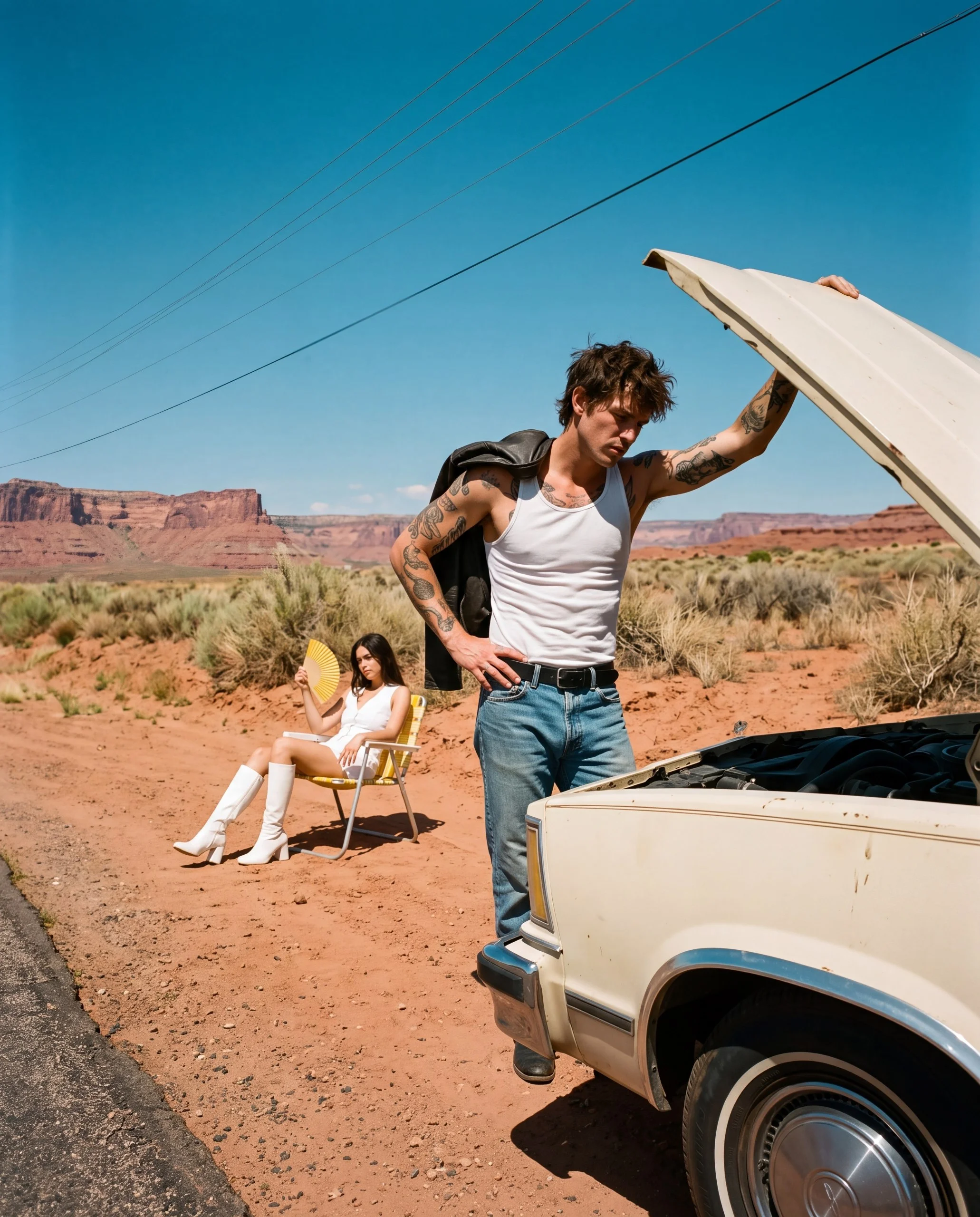
Comparison 1: desert fashion editorial — hero product or cinematic story?
Nano Banana 2.0
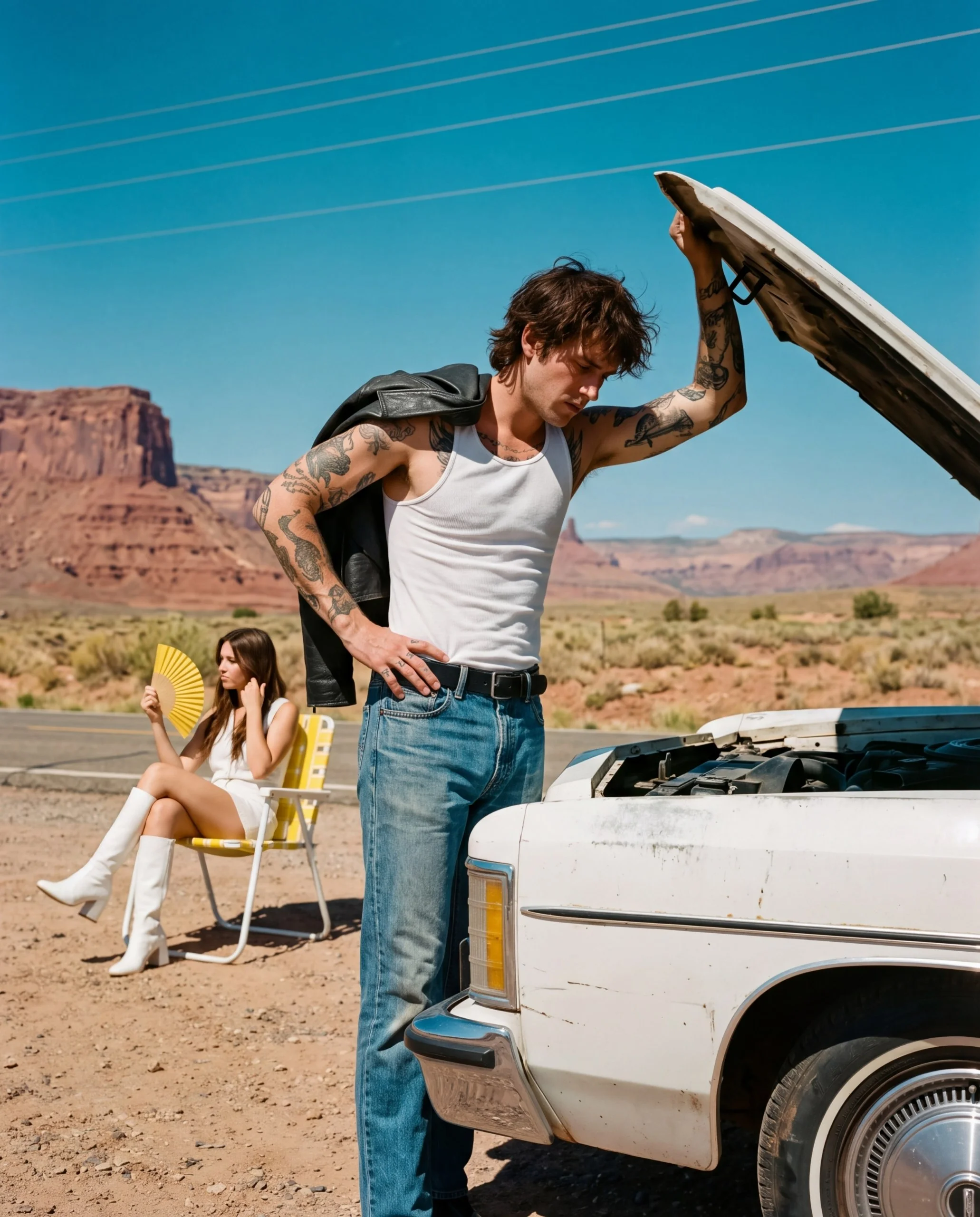
Nano Banana 2.1
Left: Nano Banana 2.0, a tighter frame on the male model. Right: Nano Banana 2.1, more road, sky and power lines.
The 2.0 image is more model-led. The male subject fills a much larger part of the frame. His tattoos, jeans, white tank top and jacket are easier to inspect. The woman in the chair reads as a secondary narrative element.
The 2.1 image pulls the camera back. The longer stretch of road, red landscape and power lines make the result feel more like a travel campaign. That wider framing gives the location more narrative weight — but means the clothes occupy less of the image. The spatial relationship between the man’s lower leg and the front of the vehicle also deserves a closer look before approval.
What this means for a brand: if the objective is to sell a specific look, the 2.0 composition is arguably stronger. If the objective is to sell the mood of a road-trip collection, 2.1 offers a more location-led option. Neither framing is universally better.
Comparison 2: Y2K fashion editorial — immediate focal point or complete styling?
Nano Banana 2.0
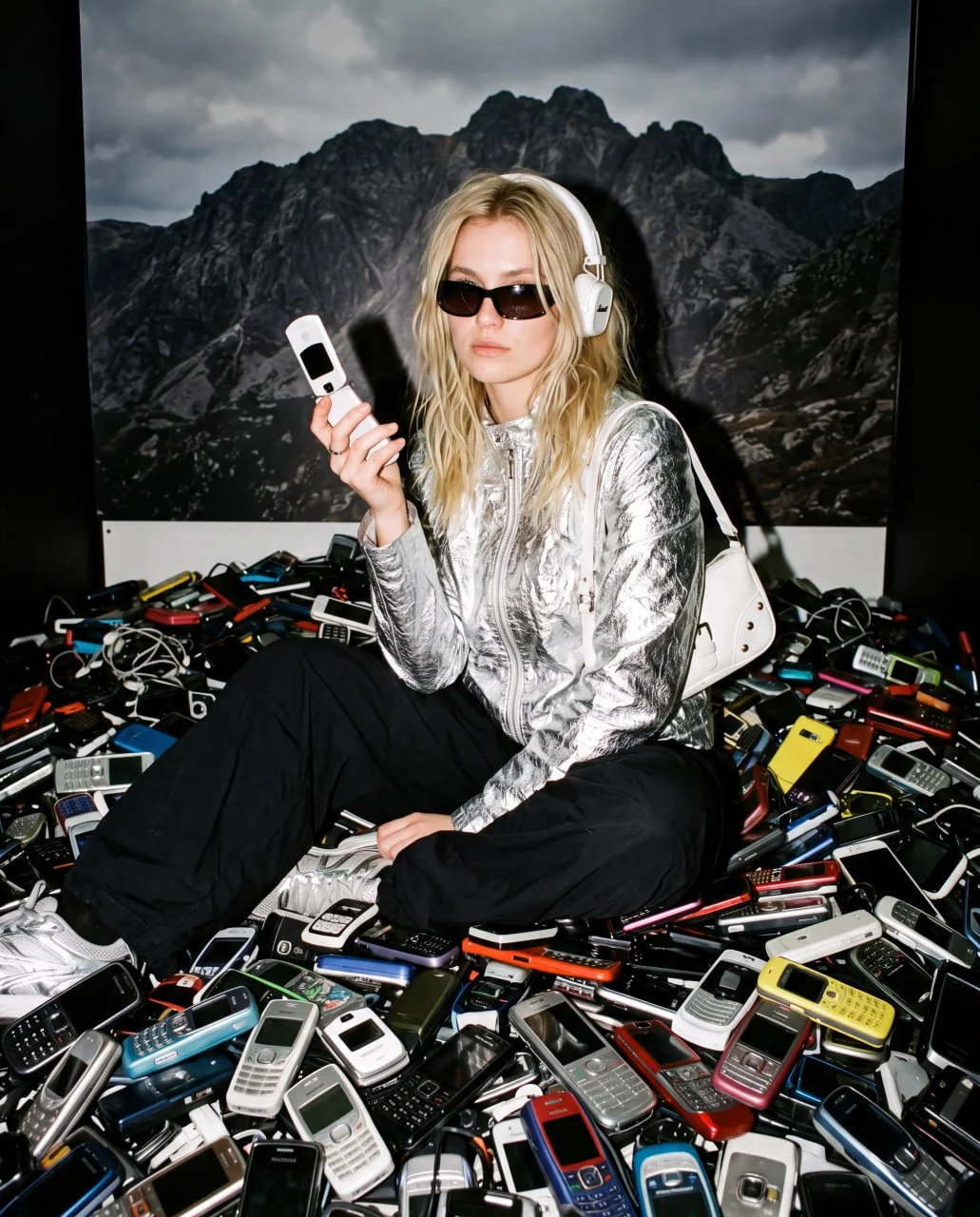
Nano Banana 2.1
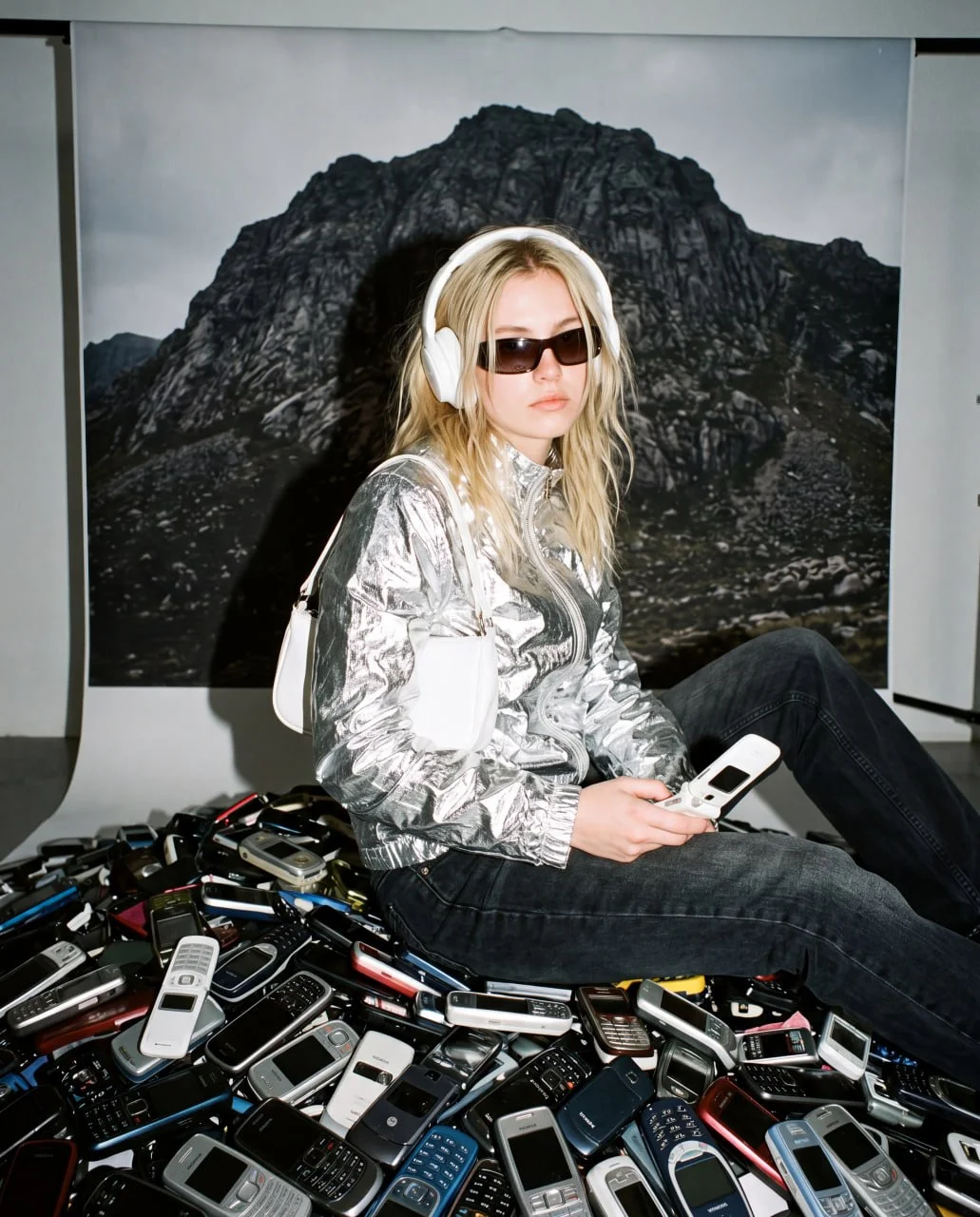
Left: Nano Banana 2.0, phone held near the face. Right: Nano Banana 2.1, a wider view of the outfit and set.
Both images establish the early-2000s aesthetic through metallic clothing, dark sunglasses, chunky headphones and piles of older mobile phones.
The 2.0 version creates a clearer central gesture: the open flip phone sits next to the model’s face, immediately connecting person and object. It is a strong portrait-first composition that could work as a fashion or tech-retro social ad.
The 2.1 version shifts toward the overall look. More of the seated posture and the accessories are visible. At the same time the handset is less prominent and the edges of the studio backdrop are more apparent. That exposed set can read as intentional behind-the-scenes styling — or as a distraction if the brief asks for an immersive fictional environment.
What this means for a brand: use subject hierarchy as a selection criterion. When the phone is a hero prop, the 2.0 result tells that story more immediately. When the brief emphasises styling and the full outfit, 2.1 provides a different, potentially useful composition. For an advertisement of a specific phone model, neither output should be treated as SKU-accurate without a source-image check.
Comparison 3: luxury automotive lifestyle — nightlife energy or visual focus?
Nano Banana 2.0
Nano Banana 2.1
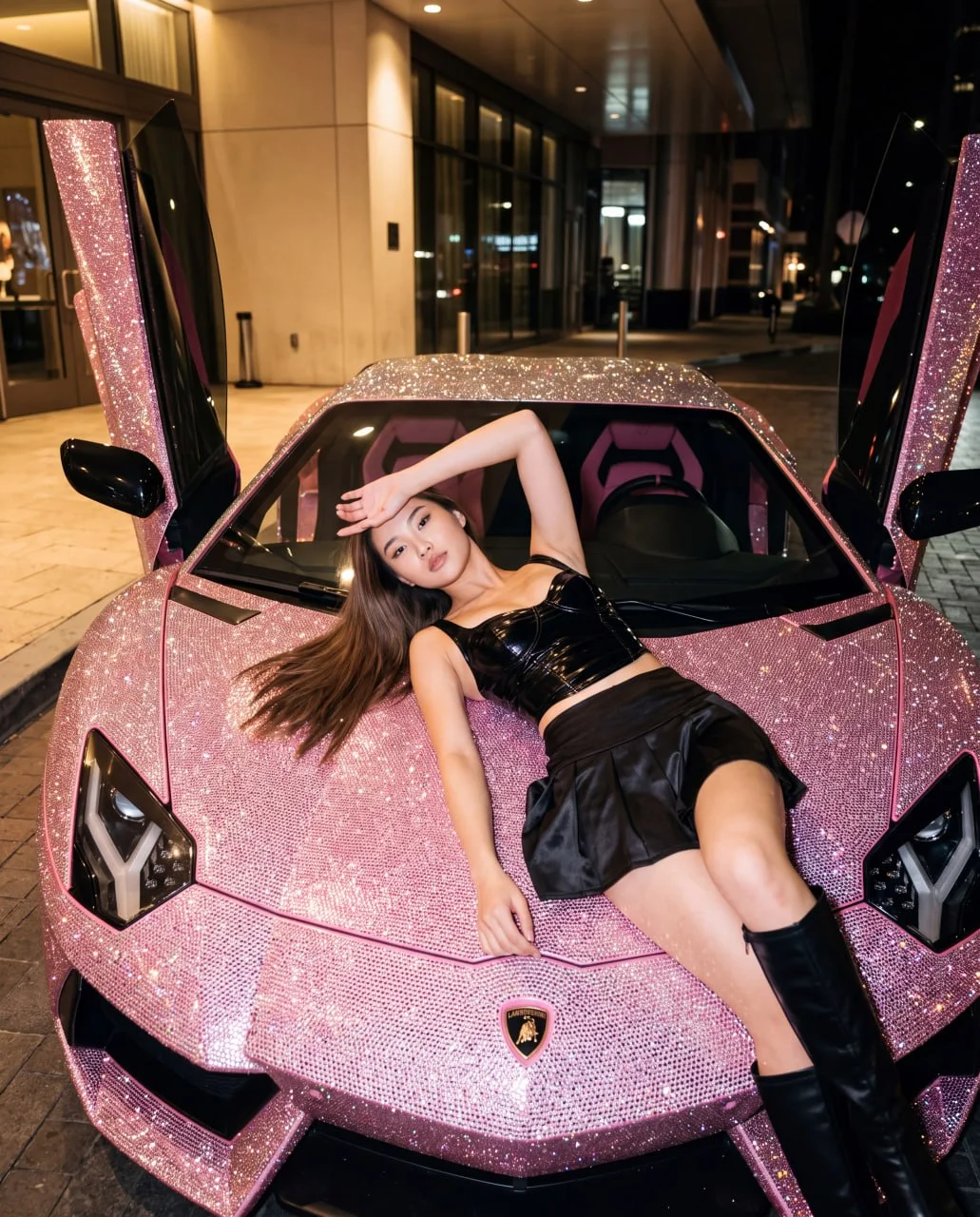
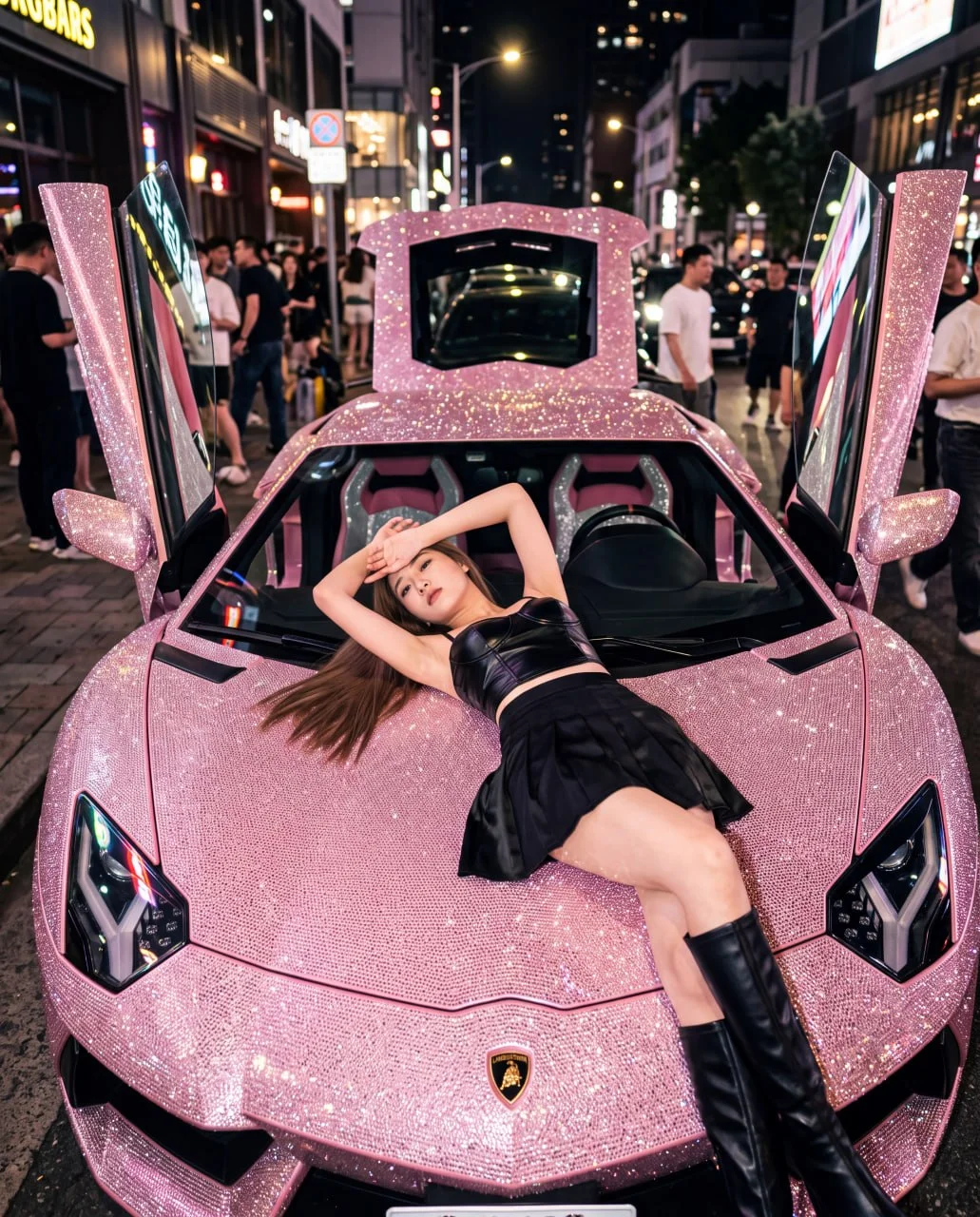
Left: Nano Banana 2.0, a crowded nighttime street. Right: Nano Banana 2.1, a calmer architectural background.
The 2.0 image feels like an energetic street-culture post. Passers-by, traffic lights, shop signs and distant headlights make it look like a spontaneous nighttime moment. That may be exactly the appeal for a trend-driven social campaign.
The 2.1 image simplifies the visual field. Against a calmer building entrance, the glittering bodywork and the reclining pose read more clearly. Fewer background elements compete for attention, and the shot behaves more like a hero asset.
In both images, however, an automotive client would still need to compare headlight shape, bodywork, badge, panel geometry and door details with the approved vehicle reference. A convincing visual is not proof of model-specific design accuracy.
What this means for a brand: for a controlled hero image we would shortlist the 2.1 composition. For a social-first nightlife concept, the older 2.0 image has a distinct creative advantage.
The common lesson from all three examples
The newer model does not automatically create the better campaign asset. It can produce a different visual interpretation of a concept. What matters is whether that interpretation serves the approved creative direction.
That is why production teams should score visual appeal, brief adherence, product fidelity and readiness for publication separately rather than collapsing them into a single preference.
Try your own brief
The most useful comparison is the one built around your product, references and creative requirements — not someone else’s showcase prompt. Start creating for free with Mujo.
What independent creators and practitioners found
Our three pairs are illustrative. For a broader perspective we also reviewed published third-party tests. These are useful precisely because they sometimes disagree, use small samples, and reveal failures that broad model rankings miss.
1. Text rendering is better on average, but never skip proofreading
In a small test reported by ppl.studio, Nano Banana 2.1 reproduced requested text correctly in 9 of 9 generated images, compared with 7 of 9 for 2.0. The task included slides, notes and phone-screen text. Encouraging for social assets and presentation concepts, although nine examples per model cannot establish an enterprise reliability rate. [6]
A counterexample comes from SYNTX’s comparison on Habr: in one controlled prompt for a technical interface, 2.0 satisfied 10 of 10 listed requirements while 2.1 satisfied 9 of 10, because 2.1 added an unrequested word. In an infographic test, 2.1 placed callouts more cleanly but again added an extra title. [7]
Production implication: let the model explore layout, but validate every approved word, number, claim, price, disclaimer and call to action. For regulated or strictly branded marketing, final copy often belongs in a controlled design layer rather than baked into generated pixels.
2. Product photographs can look right while the SKU is wrong
In Fuser’s same-prompt tests, 2.1 was the only model among 2.0, 2.1 and Pro to satisfy all of the specified lighting and copy-space requirements in a ceramic-product scene. Yet in a separate serum-bottle edit, all three models changed a small detail of the dropper collar despite instructions to preserve the original product. [5]
Astria’s fashion and ecommerce review reached a similar operational conclusion: product and packaging details require separate checks, even when character identity, styling and campaign composition are convincing. In a packshot-to-lifestyle test, 2.1 preserved all 11 measured lines of packaging copy while 2.0 preserved 10 — but the test did not guarantee exact hardware or typography. Astria explicitly warned that its 31 qualification samples were not a statistically reliable ranking. [4]
Production implication: for beauty, fashion and ecommerce, use approved packshots as ground truth. Check logos, closures, seams, button counts, labels, embroidery and colourways independently of whether the overall creative looks premium.
3. Character consistency has improved, but identity is not guaranteed
Google’s model card reports a substantial advantage for 2.1 on multi-character consistency. [2] Independent tests are more cautious. In ppl.studio’s small face-likeness evaluation, automated judges preferred 2.1 in 40 out of 64 judgments versus 24 for 2.0; those judgments came from repeated evaluations of 16 photo pairs, not 64 independent scenes. The authors described the result as suggestive rather than conclusive. [6]
Fuser also documented a case in which Nano Banana Pro preserved the likeness of a reference portrait more closely than either 2.0 or 2.1. [5]
Production implication: a fashion campaign featuring a recurring cast should use consistent identity references, select approved frames and verify the same person across scenes — particularly when expressions, lighting or camera distance change.
4. Better editing scores do not eliminate change drift
Google’s own benchmark shows stronger editing scores for 2.1. [2] But Model Fatigue tested repeated modifications to images and found that both versions could change areas that were supposed to remain untouched. Its pixel-level measurement is unusually strict and is not the percentage of the picture that looks visibly wrong. The authors tested only three source images, so the result should not be generalised into a universal failure rate. [8]
Production implication: for approved campaign assets, save originals and versions, compare edits against the source, and inspect unaffected areas. A chain of iterative prompts is not equivalent to locked layers in a conventional image editor — which is why structured batch production and version comparison matter more than prompt skill at scale.
Pricing: why 2.1 matters for high-volume production
Google’s standard Gemini API output-image list prices, checked on 12 October 2026, are below. These are not Mujo platform prices, and they exclude input tokens, text and thinking output tokens, retries and any additional service charges. [3]
For a batch of 10,000 images at 2K that is approximately $1,010 for 2.0 versus $504 for 2.1 in image-output charges alone: $506 less before other costs. [3]
There is a qualification many price comparisons overlook: the newer model’s non-image token rates are higher. Google’s listed standard API input rate is $1.50 per million text, image and video input tokens for 2.1, versus $0.50 per million text and image input tokens for 2.0; text and thinking output is likewise priced differently. Actual all-in savings depend on the workload. [3]
Cost per approved asset = total generation, retry, editing and review cost ÷ number of approved deliverables.
A model that is inexpensive per image can still be expensive if packaging errors, unwanted objects or repeated edits increase revision time. Conversely, better prompt adherence can create savings beyond the headline API price cut. These effects need to be measured on your own production briefs rather than assumed.
When should a brand use Nano Banana 2.1?
Our recommendation: use 2.1 as the default candidate for most new image-generation tasks, not as an automatic sign-off. Keep a fallback route for briefs where an earlier model or another tool produces a better verified asset.
A practical production workflow for enterprise teams
A reliable process separates the act of making a good picture from the act of approving a correct picture.
Six steps, in order
- Define the creative brief. Goal, channel, mood, layout and non-negotiable constraints.
- Assign references by role. Product ground truth, character identity, styling inspiration, approved visual identity.
- Generate alternative directions. Compare 2.1 against another model when the stakes justify it, and record the settings and inputs.
- Validate product and brand fidelity. Packaging, text, identity, palette, approved claims and any regulated disclosures.
- Approve the exact version. Keep a record of the selected image and every subsequent change.
- Produce channel variations. Resize and adapt only after the master has passed QC, then re-check crops, readable copy and critical details.
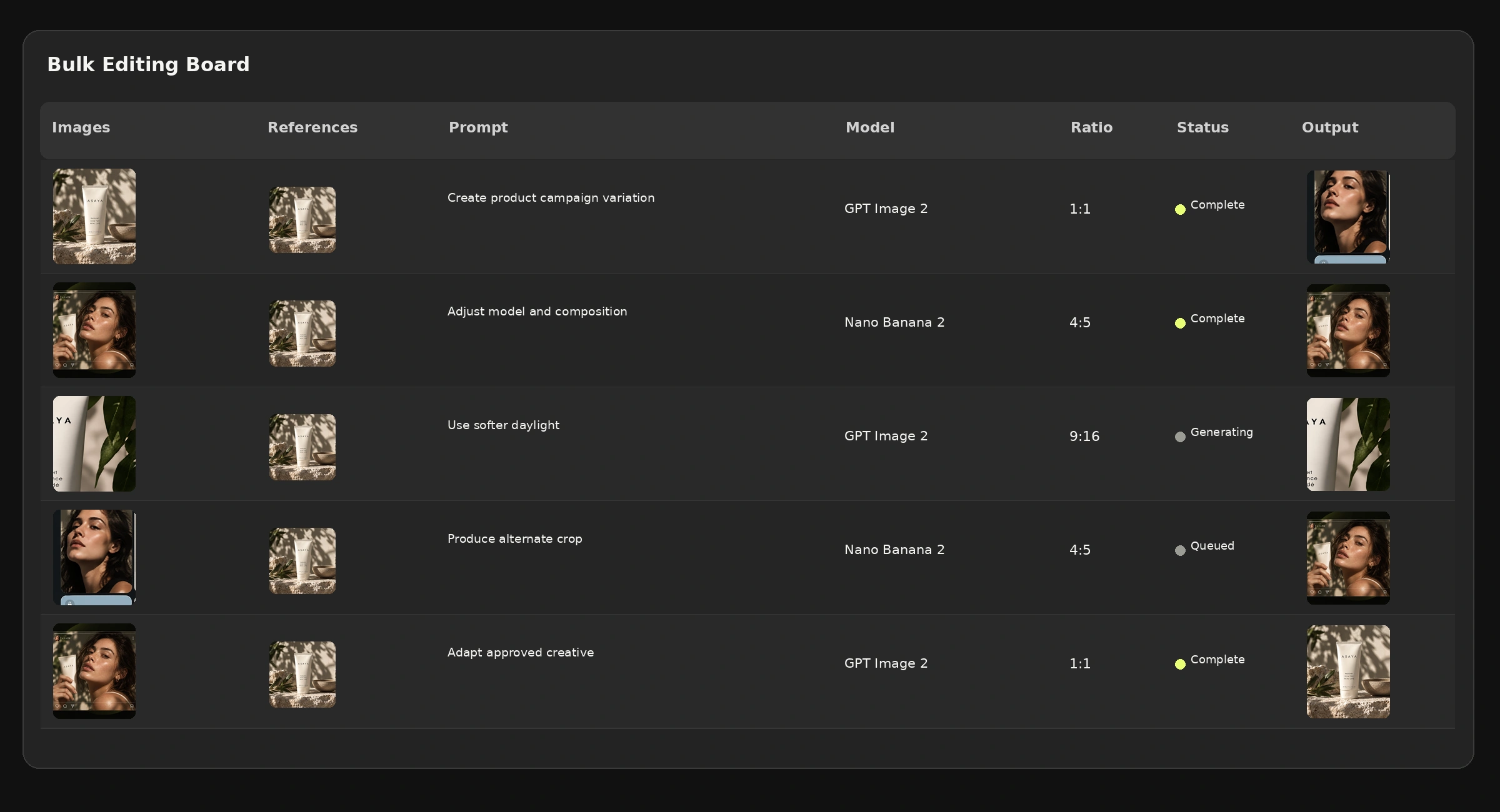
This matters most for teams producing dozens or hundreds of assets from one campaign concept. The challenge is no longer producing attractive variations; it is doing so without losing consistency or control. In Mujo that structure lives in Creative Controls, the Node Editor and the Bulk Editing Board, so the approved direction is reused rather than re-described.
How to run a fair comparison yourself
If you are assessing model adoption, one result per brief is not enough. At minimum, use the same source images, written creative constraints, aspect ratio and output resolution. Record the actual model ID and thinking configuration; 2.1’s default thinking level is medium, which affects both speed and cost. [1][6]
Score each output separately on
- □Creative quality.
- □Compliance with the written instructions.
- □Product and character fidelity against approved references.
- □Text accuracy, word by word.
- □Whether it would pass production approval as-is.
- □Time to approval, including revisions.
- □Total cost, including retries and edits.
Include failed samples instead of showing only the best image. A model switch should be justified by approved-output performance, not the nicest image in a launch thread.
Final verdict: an important upgrade, not an automatic approval button
Nano Banana 2.1 is a convincing new default for creative exploration and many production workflows. Google’s evaluations show better aggregate quality, and its standard API image-output costs at 1K and 2K are roughly half those of Nano Banana 2. [2][3]
Yet the central enterprise risks remain familiar: the wrong label on the right-looking bottle, an altered garment detail, an extra word in the creative, or a background changing during a seemingly minor edit. Independent practitioner tests show why all of these deserve attention. [4][5][7][8]
Our own three visual pairs reinforce a simpler point: even when one model is newer, the creative brief determines which image is better. Sometimes the wider, cleaner result is the right choice. Sometimes the tighter, busier, more immediate composition communicates the campaign more effectively.
Frequently asked questions
Is Nano Banana 2.1 better than Nano Banana 2.0?
On Google's published aggregate evaluations, yes: 2.1 scores higher across overall preference, editing, product consistency and multi-character consistency. But the better choice for a particular campaign still depends on framing, references, instructions and approval requirements. [2]
Is Nano Banana 2.1 half the price of 2.0?
For the image-output component of Google's standard API pricing, it is approximately half at 1K and 2K. At 4K the saving is approximately 25%. Input, text and thinking charges may change the all-in comparison. [3]
Can Nano Banana 2.1 reproduce a product exactly?
Do not assume so. Third-party tests show that a model may preserve the overall product and label but change small details such as caps, closures, materials or typography. Product-led campaigns should be checked against approved source photography. [4][5]
Is Nano Banana 2.0 being shut down?
Google's deprecations page lists Nano Banana 2.1 as the recommended replacement for gemini-3.1-flash-image, but as of 12 October 2026 it lists no announced shutdown date for that stable Nano Banana 2 model. [9]
What should a creative team measure before switching?
Track the share of assets approved without revision, product or identity errors, text corrections, average editing time, generation latency, and cost per approved asset across the same representative set of real briefs.
Related reading
- Build Once, Reuse Everywhere: turn your brand brief into an AI creative system
- How to use fewer AI credits without losing quality
- How to produce creative variations in bulk
- How to use reference images and Creative Controls
- AI Creative Workflow Setup — have the production system built for you
Try your own creative brief in Mujo
Don’t judge a model only by someone else’s examples. Bring your own concept, references and visual requirements — compare image quality, check your brief, and choose the direction that works for your brand.
Sources and research notes
Official technical documentation
- Google AI for Developers — Gemini Nano Banana 2.1 model documentation. Feature changes, supported output sizes, API model ID, thinking levels and reference workflows. Accessed 12 October 2026.
- Google DeepMind — Nano Banana 2.1 model card. Underlying model, internal evaluation scores and documented limitations. Accessed 12 October 2026.
- Google AI for Developers — Gemini API pricing. Standard output-image and token prices for both models. Accessed 12 October 2026.
Independent practitioner comparisons
- Astria — Nano Banana 2.1 for fashion, ecommerce and marketing. 31 qualification samples; tests on product, packaging text and identity. Note its non-representative sample and unmatched defaults.
- Fuser — Nano Banana 2.1 vs Nano Banana 2 vs Pro: same-prompt test. Examples of correct shadow placement, product-cap drift and imperfect face retention.
- ppl.studio — Nano Banana 2.1 vs Nano Banana 2: half the price, tested. Small test of face likeness, text reproduction and latency, with experimental caveats. Note: its 4K price figure conflicts with the current official Google pricing page; this article uses Google’s official price.
- SYNTX on Habr — Nano Banana 2.1 vs Nano Banana 2: three identical prompts. Small Russian-language tests of exact-copy compliance and technical infographic layout.
- Model Fatigue — Nano Banana 2.1 or Nano Banana 2?. Small sequential-edit study, including the limitations of pixel-level change metrics.
- Google AI for Developers — Gemini model deprecations. Recommendation to move from gemini-3.1-flash-image to gemini-nano-banana-2.1; no shutdown date listed for the stable 2.0 model when checked.
Disclosure on visual examples. The six Mujo-supplied images are labelled by the model version indicated in their source filenames. Prompt parity, reference-image parity, thinking level, provider and seed have not been independently documented. The qualitative visual commentary is an editorial assessment of these exact samples, not a controlled or generalisable measurement of either model’s performance.