Choose Celtra
you have approved master creative and need thousands of compliant variants across placements and markets.
Celtra is the enterprise end of this category: a creative automation platform that takes approved assets and produces pixel-perfect variants across every placement, market and format an omnichannel campaign needs. Puma, Unilever and TripAdvisor are the kind of names it works with. It assumes the creative exists. Mujo is where that creative comes from when photographing or designing it is the constraint.

Three lines before the detail. If the first one describes you, Celtra is the better purchase and the rest of this page will not change that.
you have approved master creative and need thousands of compliant variants across placements and markets.
you have a brief and a product, and the master creative itself is what has to be produced.
one automates assembly from existing assets; the other generates the assets.
Three things this platform does not do, said before the arguments in its favour.
No ad serving, no placement specs library, no media-side workflow.
Mujo produces formats by generating them, not by templating a master to spec.
No procurement-scale deployment, ad-ops integrations or placement compliance.
A practical comparison of the workflow each platform is designed to support, across nine dimensions.


Celtra automates creative execution: take approved creative, apply a design system, and produce every variant an omnichannel campaign needs, pixel-perfect and compliant, with analytics on what ran. It serves marketing, media and creative teams at enterprise scale, on quote-based contracts with no public pricing and no free tier.
Mujo sits one step earlier. The image workspace runs Nano Banana Lite, Nano Banana 2 and Nano Banana Pro, GPT Image 2, Midjourney, Seedream 5.0 Lite and Seedream 5.0 Pro, Grok Imagine and Kling 3.0 Image and the video workspace runs Veo 3.0 and Veo Fast, Kling 3.0, Seedance 2.5 and Seedance 2.0, with Creative Controls, a shared Prompt Library, an Asset Library and a Node Editor — all aimed at producing the master creative rather than scaling it. Automating the distribution of creative you already have and generating creative you do not are different problems. A team with neither solved usually feels the second one first, because nothing can be automated until something exists.
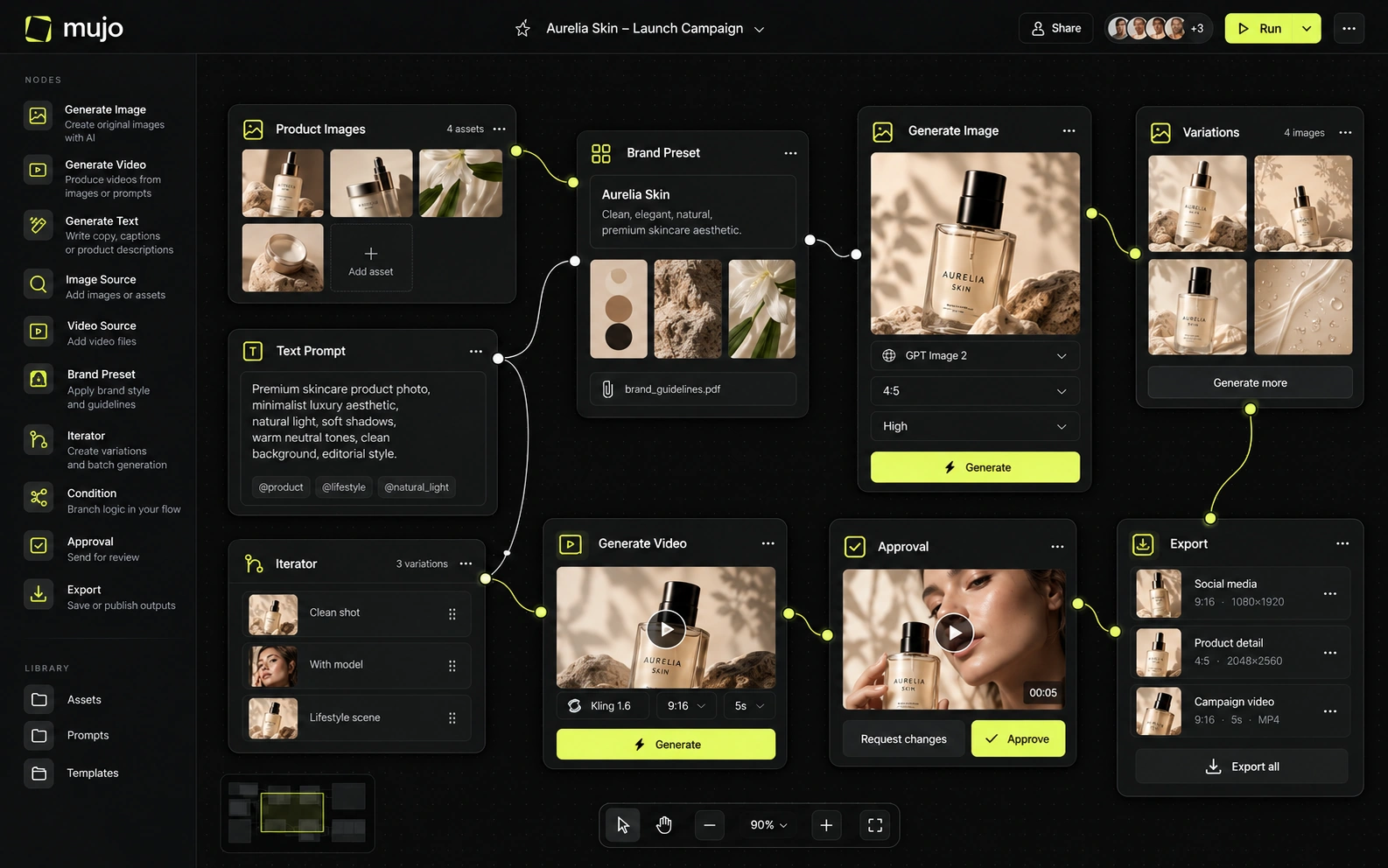
Model access is not part of Celtra's proposition. It is a production and governance platform, and generative features serve execution rather than origination.
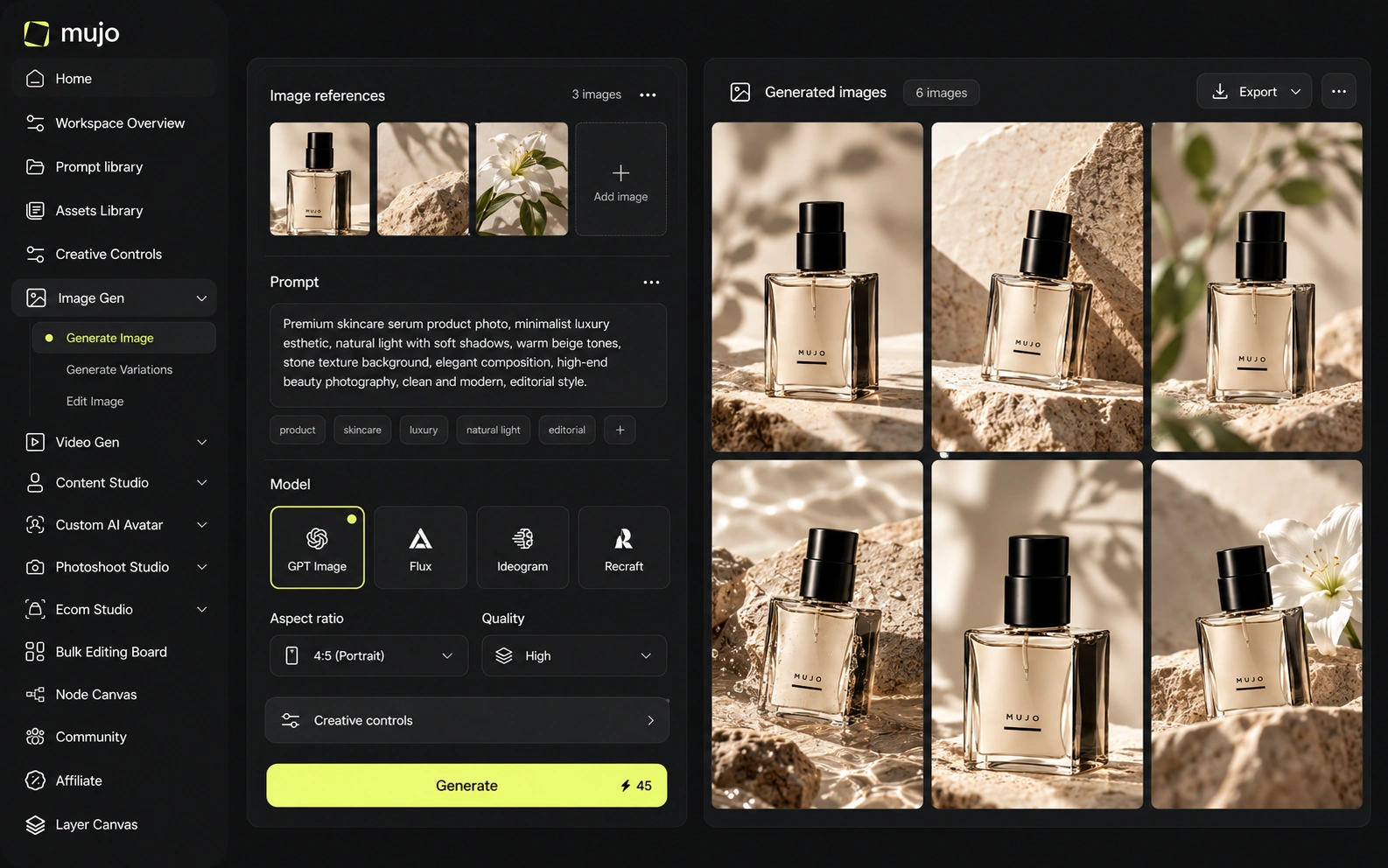
Mujo's nine image and five video engines exist to originate: run a brief across them with prompts, references and Creative Controls held constant, then take the winner forward. Two questions, kept apart: whether your bottleneck is producing the master creative or distributing it, and whether the master itself is getting more expensive each season.
Celtra's control is systemic: design systems, rules and templates that guarantee every variant is on-brand and within placement specification. That is a governance capability, and at enterprise scale it is worth a great deal.
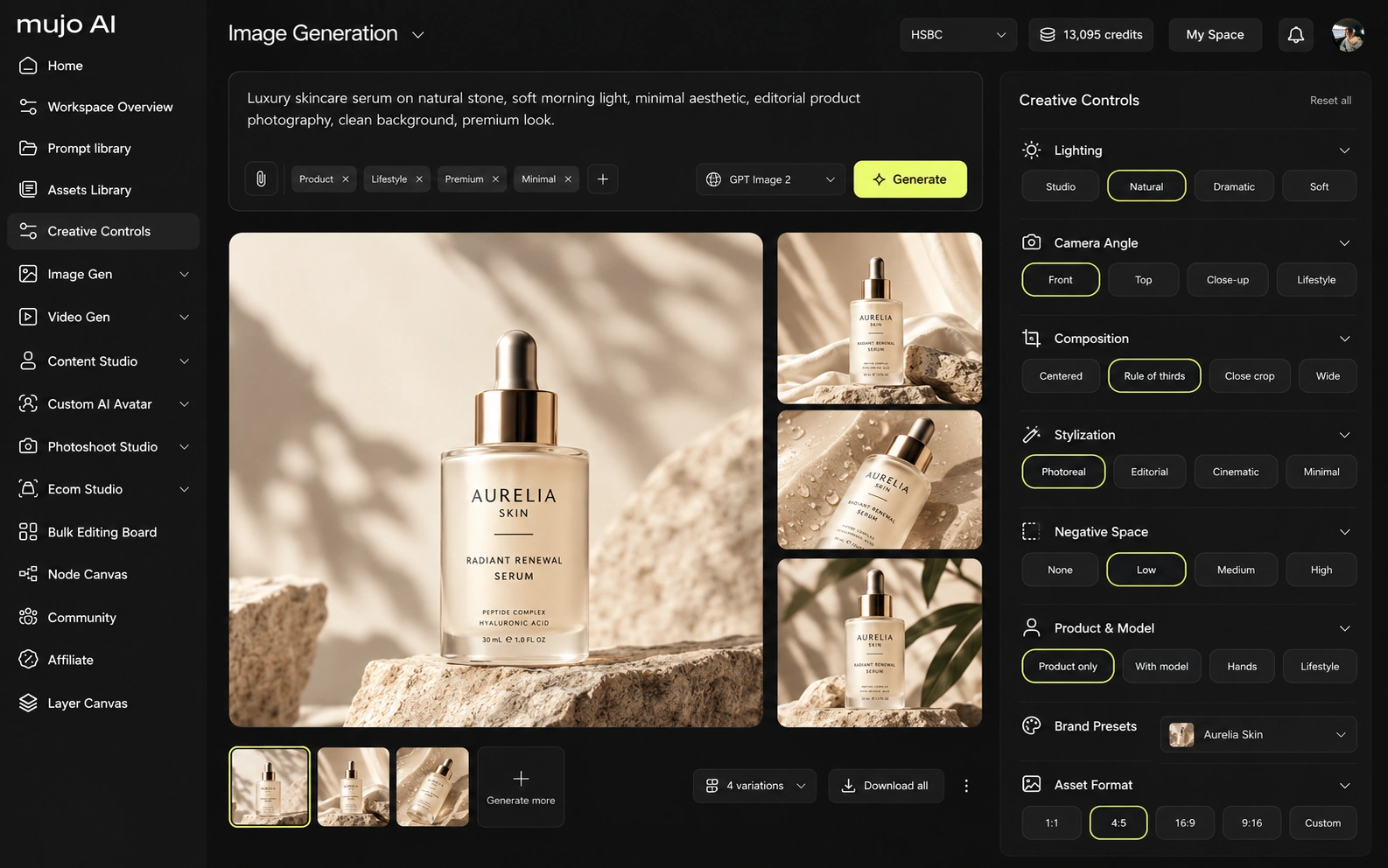
Mujo's Creative Controls are upstream of governance — lighting, pose, expression, camera angle, location and style, set as named parameters so the master creative can be produced and reproduced. Rules make sure the right thing ships everywhere. Parameters make sure the right thing exists in the first place. Both are real problems and they are not the same problem.
Celtra produces video variants from supplied master assets, with the same rules and specifications applied across placements.
Mujo generates video on five engines beside the image workspace, with Storyboards linking approved frames to motion — origination rather than adaptation.

Consistency means four things: the same person, product, look, or process. Celtra's design systems solve brand consistency across thousands of variants better than anything else in this comparison set.
Mujo works on the visual consistency of the creative itself: references, Creative Controls parameters, saved prompts, saved AI characters and shared flows, so two product photographs look like one shoot. A design system guarantees that a logo, a colour and a safe area are correct in every placement. It cannot make two generated product images look like they came from the same session. If the recurring risk is off-brand variants shipping, the CMP is the answer. If it is that the master creative takes six weeks to produce, the CMP has nothing to work with until then.

How each platform fits enterprise campaign production
Scaling approved creative across placements, markets and formats with brand and spec compliance, plus analytics on what ran.
Product Photos, Listing Images, Product Catalog Production, AI Photoshoots, Campaign Creatives and Creative Variations — producing the assets themselves.
Celtra industrialises distribution. Mujo industrialises origination. Large advertisers generally need both, and usually buy them from different vendors.
The product shot, its listing crops, its ad variants and its social cuts come out of the same approved direction. Volume is what makes commercial work expensive, not generation speed — and it is the part a Celtra comparison usually leaves out.

Mujo keeps prompts as production assets: refined with structured controls, compared across models and saved into a library of 2,500+ prompts plus your team's own setups. Celtra's reusable unit is the template and the rule set — governance objects rather than creative ones, which is exactly right for what it does.
Saved setups live in the Prompt Library where the next person can find them, instead of in the generation history of whoever happened to get it right. Whatever a Celtra session leaves behind, it is usually the output rather than the reasoning behind it.

The Bulk Editing Board and a creative automation platform both scale creative, from opposite directions. Rows are assets, columns are the variables, and one approved direction generates each result — where a CMP would take one finished master and adapt it to every placement.
Adaptation needs a master. Generation makes one. A team that only automates adaptation still waits six weeks for the thing being adapted.
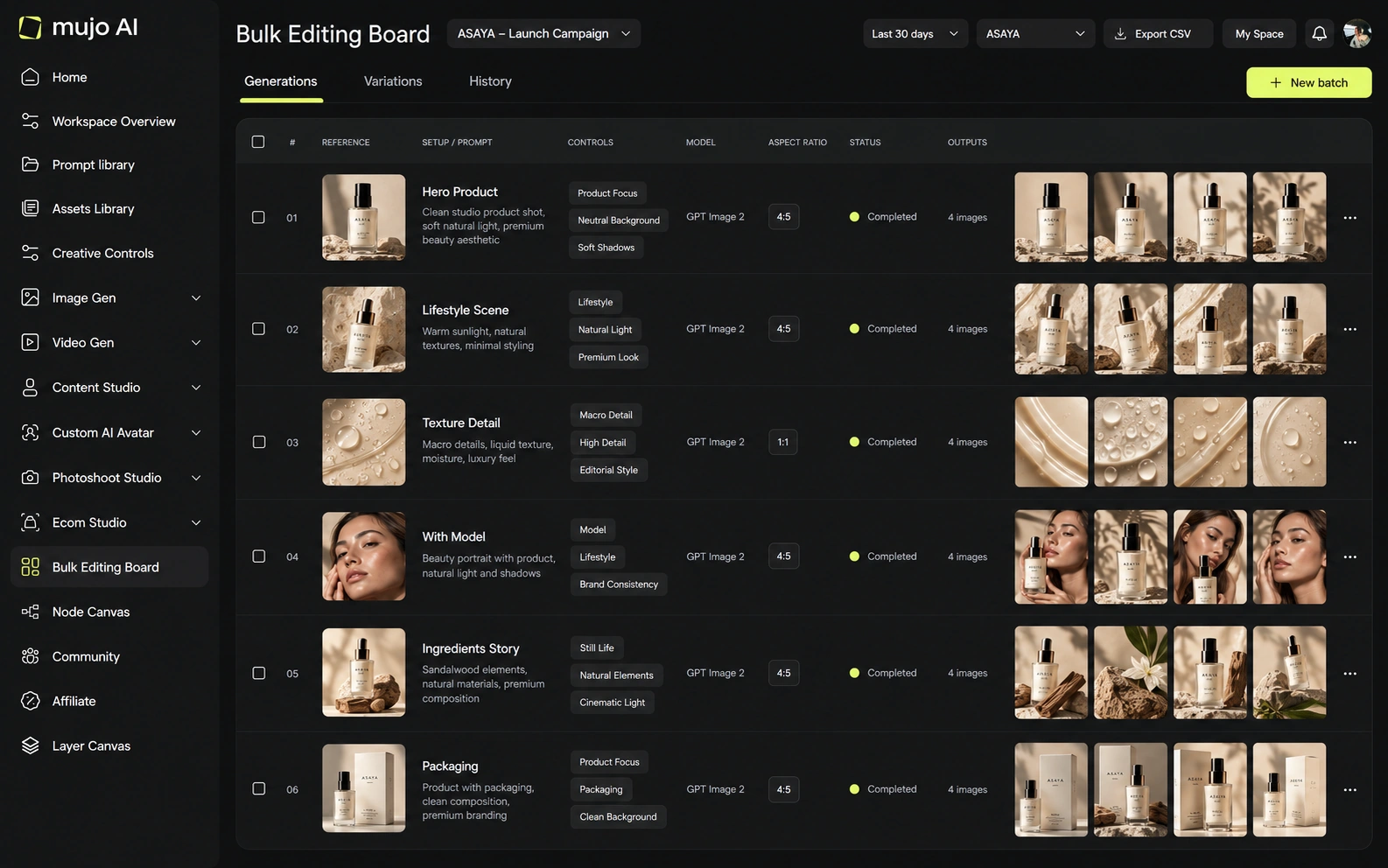
Give both the same brief: one product image in, a hero visual, three square social variants and one vertical motion ad out, then the same direction on a second SKU a week later. Notice which half of that brief each platform can even accept as input.
Use one source product image and one launch brief.
Produce the hero visual, three square social cuts and one vertical motion ad.
Prompts, references, controls and the model that produced it.
Rerun origination, then hand the approved masters to whatever scales them.
Celtra clears the first round comfortably, as does almost anything else worth evaluating. The second round is where the difference appears, and it is the round nobody gets to during a two-week trial.

Celtra operates at enterprise scale with over 450 enterprise clients, and onboarding typically runs across several days and multiple stakeholders while workflows are configured.
Mujo Enterprise is lighter to adopt: connected Node Editor flows, brand context, shared prompt and asset libraries, approval traceability, onboarding and security review, with roles on the Business plan. Time to first value differs by an order of magnitude here, and that is not a criticism of either — governance platforms are configured, production tools are opened.

Celtra does not publish pricing. Contracts are quote-based and negotiated per customer, there is no free version, and a demo is the entry point. Budget for implementation time alongside licence cost: onboarding involves configuring workflows with several stakeholders.
No public pricing; enterprise contracts negotiated per customer
A demo or trial is arranged through sales rather than self-serve
Onboarding runs across several days with multiple stakeholders
Reported to serve over 450 enterprise clients including major global brands
Plans Start $9, Basic $19, Pro $34, Creator $84, Business $121 (5 seats); 200-credit packs from $2.60 with no use-by deadline
Mujo's plans run from $9 to $121 a month, with up to 40% off on annual billing. Pay-as-you-go packs start at 200 credits for $2.60, credits carry no use-by deadline, and new accounts start with 20 free. An enterprise licence with an implementation project and a self-serve subscription are not comparable on price alone — compare them on which bottleneck each one removes.
Enterprise contracts govern data and content handling individually; whatever a comparison page says, the terms that apply to you are the ones in your agreement.
Specifically, on Mujo's side: users keep ownership of what they upload and of AI-generated outputs and may use those outputs commercially, subject to applicable law and third-party rights; inputs and outputs are not used to train foundation models without opt-in, and the enterprise terms extend that to the third-party models in the stack. Commercial-use permission is not rights clearance. Trademark, publicity rights and model-provider terms still apply, so client work needs human review before it ships.

What Celtra does better, and what Mujo does better. A comparison page that fills in only one side is not a comparison.


Worth reading before a trial rather than after one.

Decide by where the six weeks go. If they go into resizing and compliance, automate that. If they go into producing the master creative, automating the second half changes nothing.
Choose Celtra when approved creative exists and the problem is producing compliant variants across placements, markets and formats at scale.
Choose Mujo when the approved creative is what is missing, and producing it is what takes the weeks.
Originate in Mujo, scale and govern in a CMP. Large advertisers usually run both, and the handoff is the approved master.
Most shortlists are settled by the wrong question — which tool makes the better first asset. The question that predicts the next year is which tool still helps on the fortieth.

Short answers about Celtra, about Mujo, and about the parts that are easy to get wrong.
A creative automation platform that scales approved creative into compliant variants across placements, markets and formats, with analytics on what ran. It serves enterprise marketing, media and creative teams.
No. Mujo produces creative; it does not serve ads, manage placement specifications or govern variant compliance.
It does not publish pricing. Contracts are quote-based and negotiated per customer, with no free version and a demo as the entry point.
Yes, through Creative Variations and the Bulk Editing Board — generated from an approved direction rather than templated from a master to placement specification.
Commonly. The creative is originated in a production tool and scaled in a creative automation platform, with the approved master as the handoff.
A comparison against Celtra stays abstract until you look at the work it is about. These are the production workflows Mujo is built around, plus the neighbouring comparisons if you are still shortlisting.
Take a brief to a full set of campaign assets in one workspace.
Turn one approved creative into controlled versions across formats and markets.
Run an approved product direction across a whole SKU list.
Product photography against generated product imagery.
Open-source node graphs against a managed production system.
Licensed footage against generated production.
If variant automation is solved and producing the master creative is what still takes six weeks, that is the half Mujo covers. 20 free credits. Produce a master creative and see how long it actually takes.