A cinematic camera tool
Motion presets and shot-level control are Higgsfield's field, not Mujo's.
Higgsfield sells camera language: motion presets, cinematic moves, effects that would take a crew. Mujo sells repeatability across a campaign. If the thing you need is a shot nobody can shoot, that is not what Mujo is for. If it is sixty assets that have to look like they came from one brief, it is.
Three things this platform does not do, stated before the arguments in its favour. If one of them is what you came for, Higgsfield is the better answer and this page will not change that.
Motion presets and shot-level control are Higgsfield's field, not Mujo's.
Effects, compositing and finishing are outside the product.
Video is one output among stills, listings and social.
Where a cinematic motion tool and a campaign production system actually differ.
Higgsfield has expanded far beyond a video generator. Its current suite includes Cinema Studio, Marketing Studio, AI Influencer, Soul ID, Canvas, Supercomputer, API access, MCP, and integrations for professional post-production. It is increasingly a production operating system for video and ads. Mujo is narrower by design: it puts more emphasis on reusable creative systems for creators, marketers, product content, listings, social assets, and repeatable model comparison.
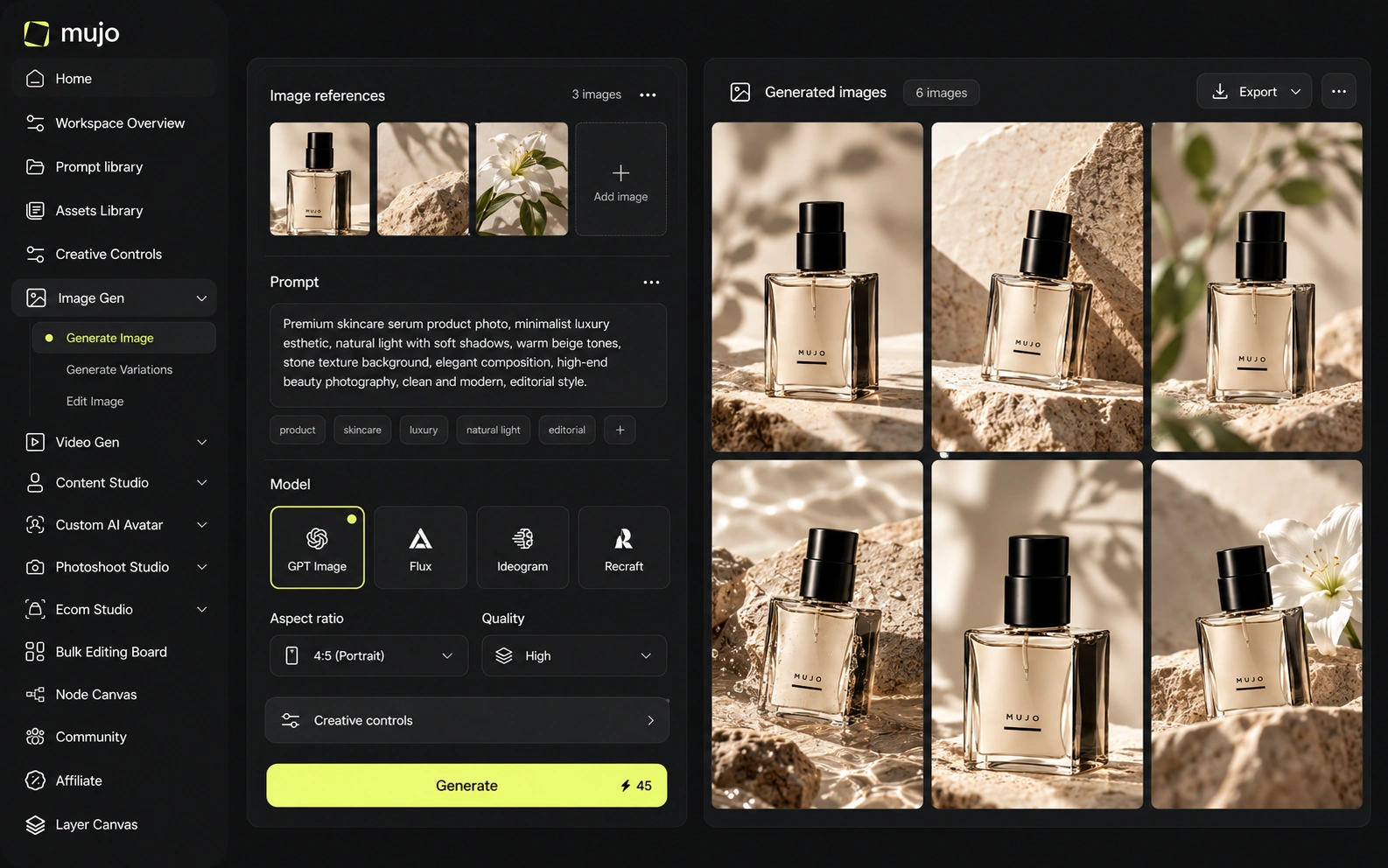
Mujo is a workflow layer over external engines — Veo 3.0 and Veo Fast, Kling 3.0, Seedance 2.5 and Seedance 2.0 for motion, Nano Banana Lite, Nano Banana 2 and Nano Banana Pro, GPT Image 2, Midjourney, Seedream 5.0 Lite and Seedream 5.0 Pro, Grok Imagine and Kling 3.0 Image for stills — with Creative Controls, a shared Prompt Library, references, an Asset Library and a Node Editor around them. Higgsfield's depth is in the motion vocabulary itself, and that vocabulary is the reason to buy it. One platform is trying to make a single shot extraordinary. The other is trying to make the hundredth asset unremarkable, in the good sense. Those goals pull in different directions.
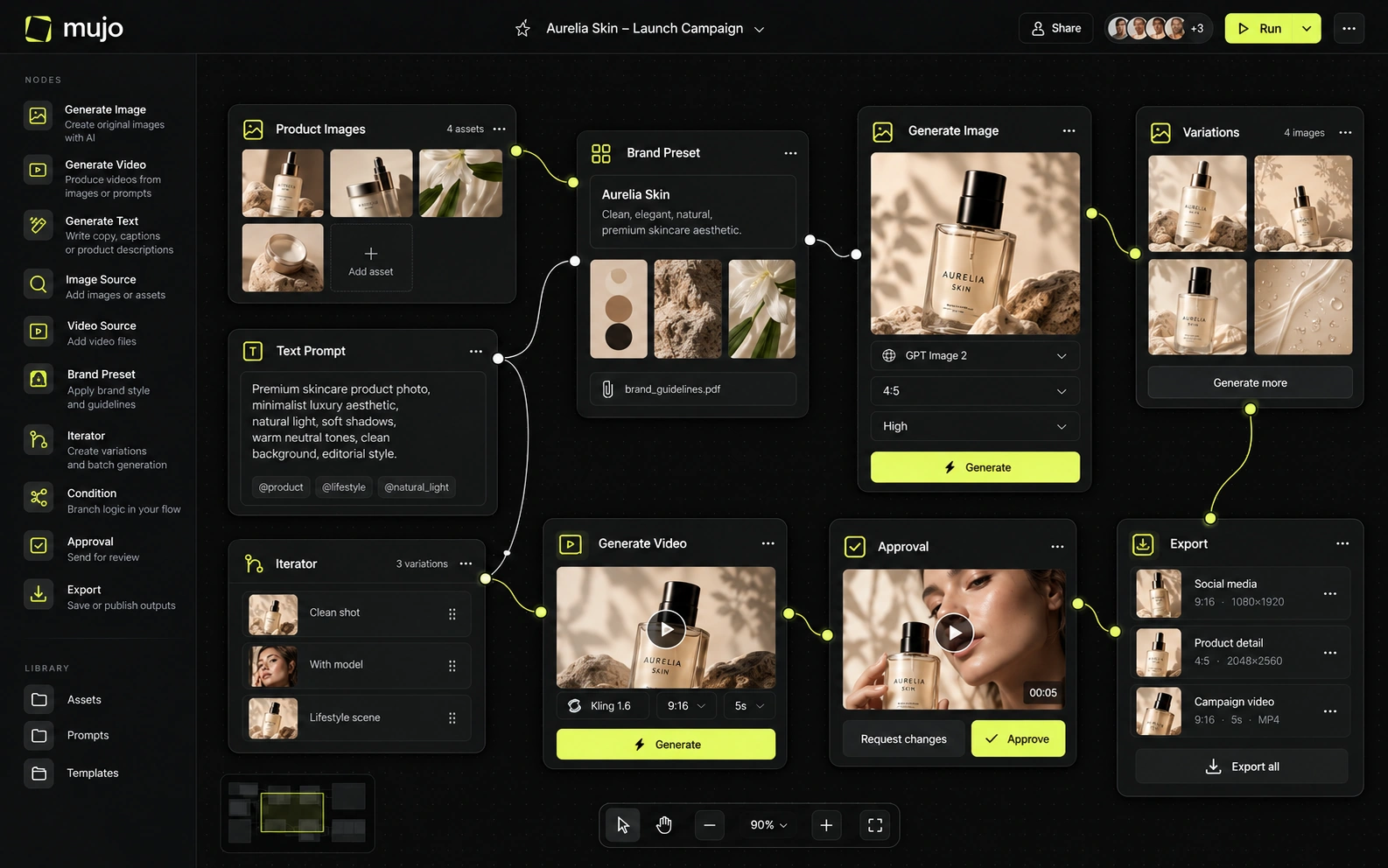
Higgsfield offers a very broad catalog of current image and video models and exposes more than 50 through its self-serve API. Cinema Studio can work across multiple models while preserving cinematic controls. Mujo also takes a multi-model approach, but its public image and video workspaces are more curated. For teams that want one place to route production across many provider models programmatically, Higgsfield's API breadth is a major advantage. For users who want fewer model decisions and more guided reuse, Mujo's curation is easier to operationalize.
Both expose several video engines, so the model list is not where the decision sits. Mujo's angle is that the same brief, references and control set feed whichever engine you pick, and that stills and motion share the workspace. Higgsfield's is that its motion controls are tuned past what a generic interface offers. Two questions, kept apart: which engine you need now, and what survives when a better one ships. Video models turn over quickly enough that the second one matters within a year.
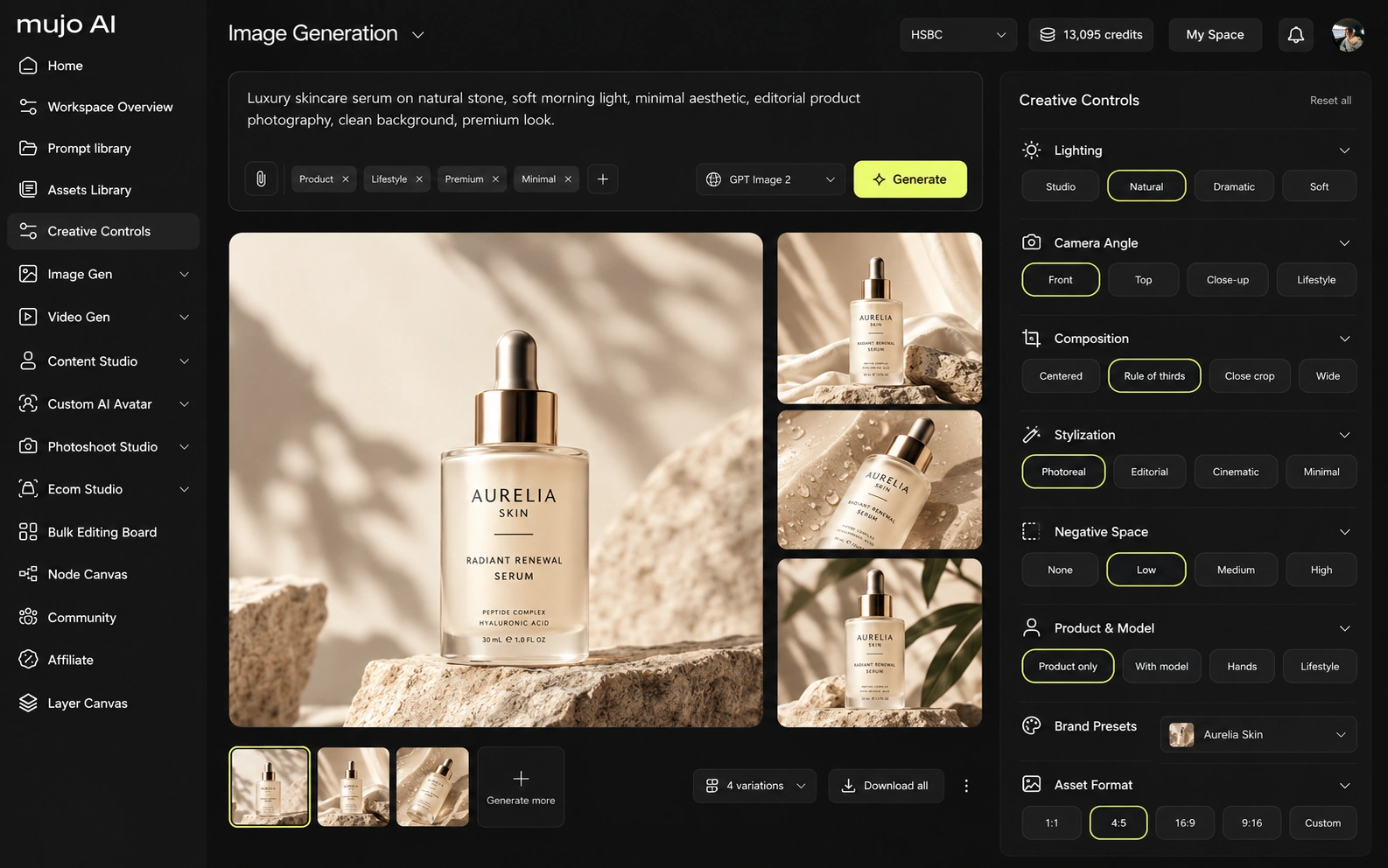
This is one of Higgsfield's strongest areas. Cinema Studio 4.0 supports up to 50 references, more than 30 camera-movement presets, lens and lighting controls, multi-shot workflows, reusable characters and locations, and clips up to 30 seconds at up to 1080p. Soul ID adds identity consistency. Mujo's Creative Controls approaches control differently: it packages parameters such as lighting, pose, expression, camera angle, location, style, and reusable prompt logic so successful directions can be repeated across content tasks. Higgsfield offers deeper film-language control; Mujo favors structured repeatability across marketing assets.
Higgsfield's controls are cinematographic — camera moves, effects, shot behaviour. Mujo's Creative Controls are campaign-level: lighting, pose, expression, camera angle, location, style, saved as named parameters that a marketer can set without writing prompt syntax. One is craft depth on a single shot. The other is coordination across a set of assets. Teams tend to need the second only once more than one person is producing.
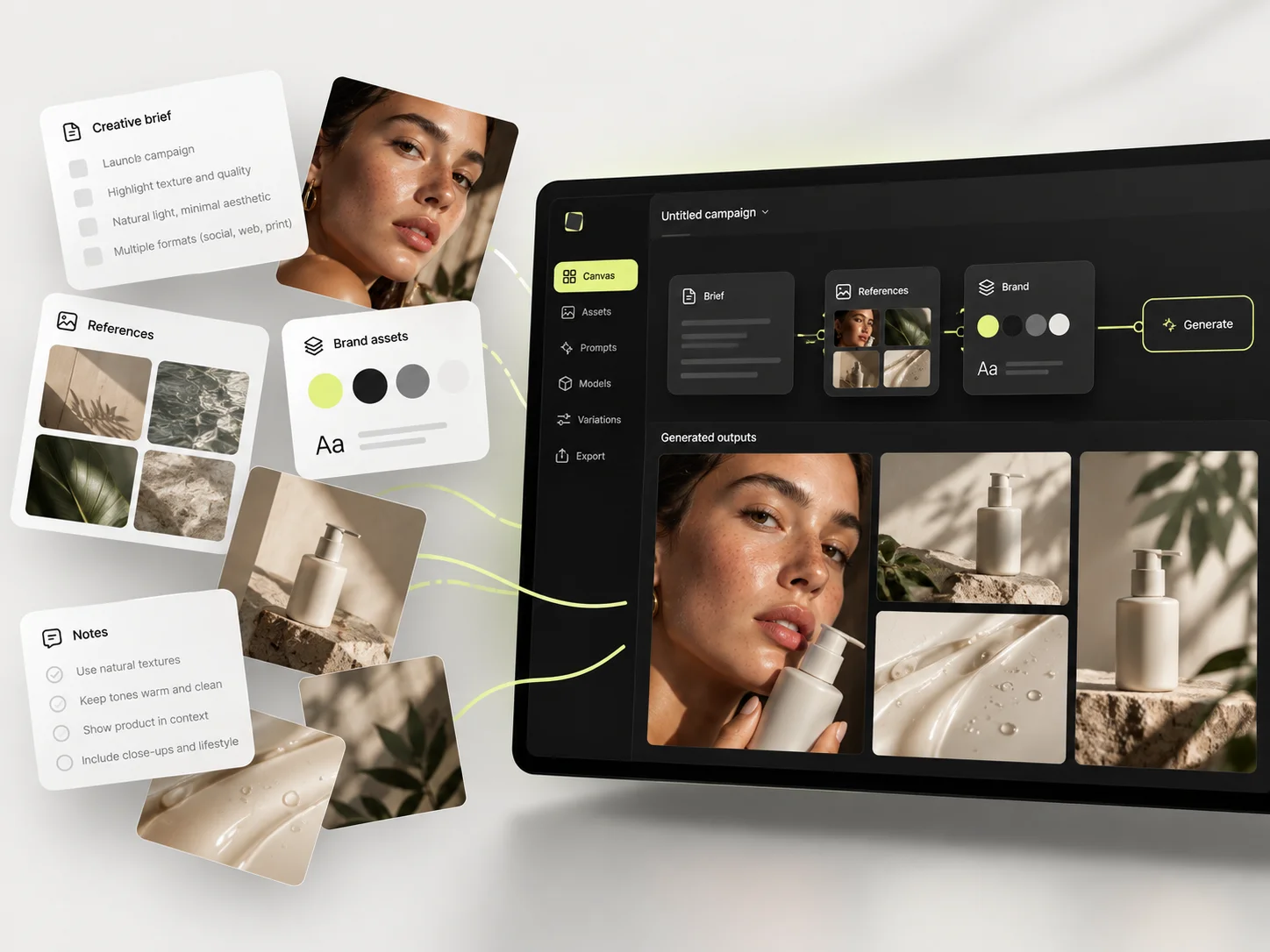
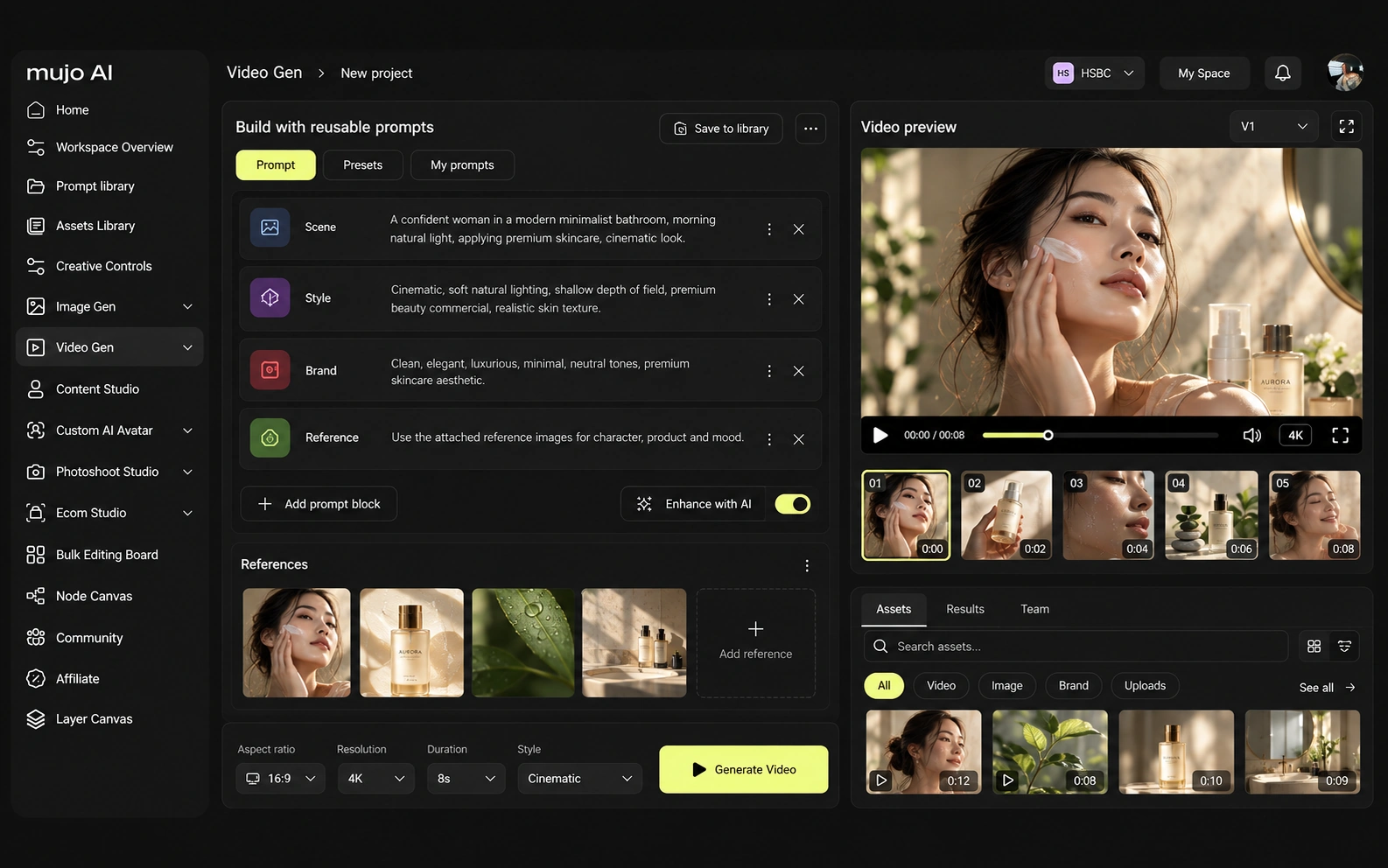
Higgsfield and Mujo both participate in the fast-moving multi-model video market, but they use video differently. Higgsfield's Marketing Studio can turn a URL or product image into ad concepts and supports formats such as UGC, tutorials, unboxing, product reviews, and TV-style spots. Supercomputer can take a brief, plan work, select models, and produce deliverables; Canvas provides a reusable node-based workspace; AI Influencer and Soul ID handle recurring talent. Mujo's layer points the other way: product and listing imagery, AI Photoshoots, campaign creatives and social cuts, with Creative Controls and the Prompt Library keeping the direction reusable.
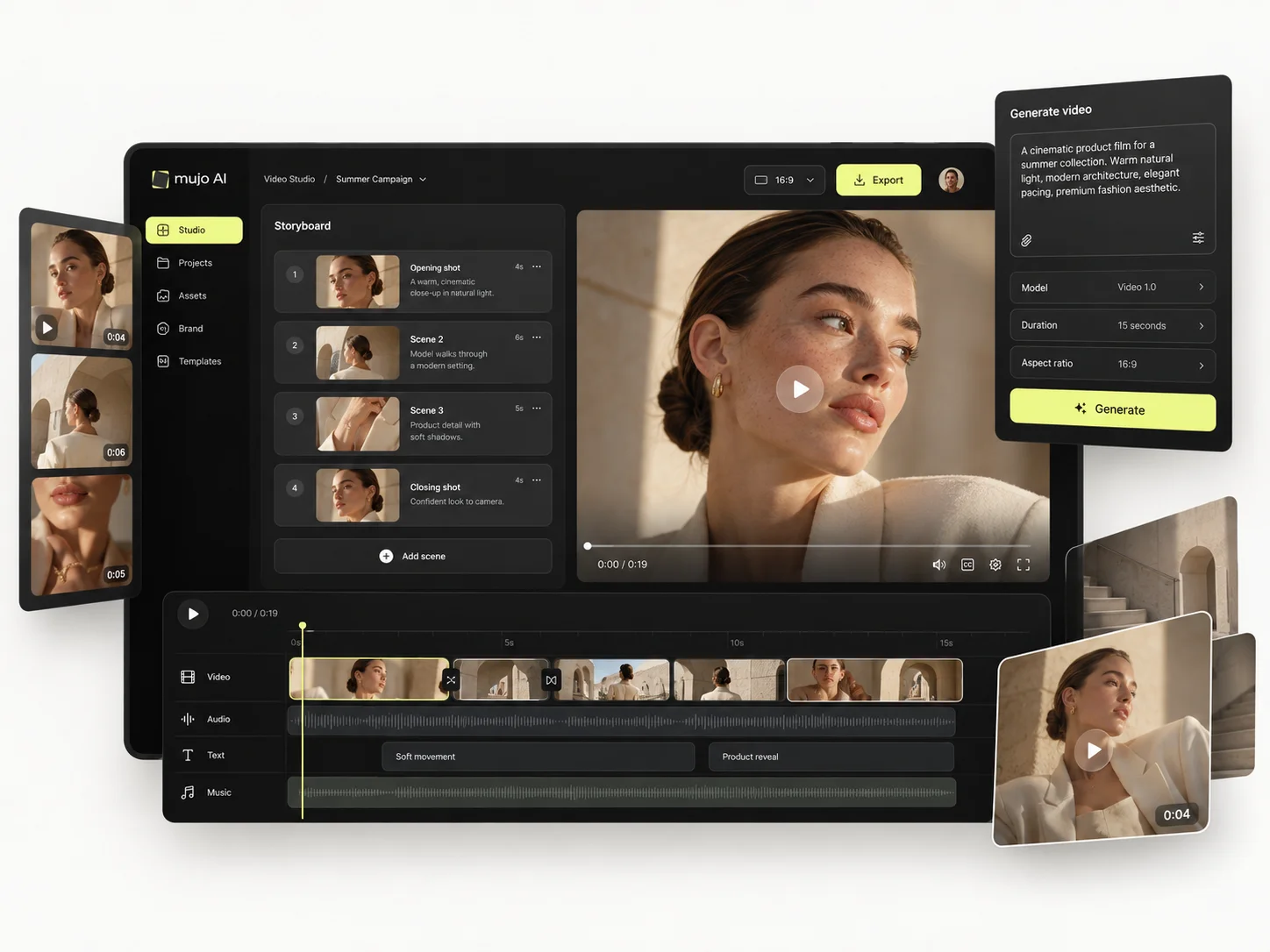
Mujo runs text-to-video and image-to-video next to its image workspace, so an approved product frame turns into a vertical ad without leaving the setup. It does not try to match Higgsfield on camera control, and a team that needs that control should buy it.
Consistency splits into four: the same person, product, look or process. Motion presets hold the look of a shot. Holding the process across a campaign is a different job.
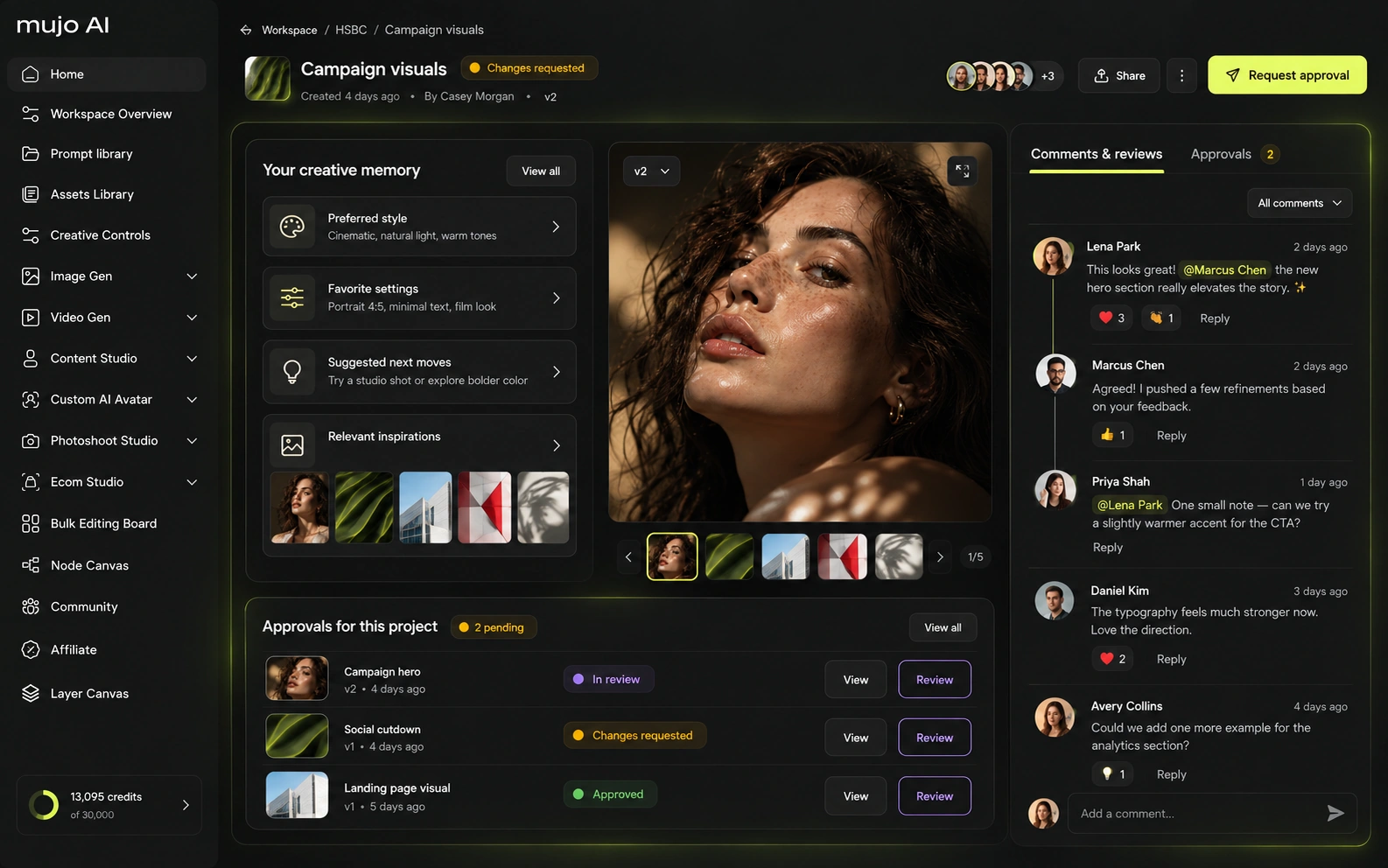
What Mujo saves is the route to the asset — references, Creative Controls parameters, saved prompts, model choice, history, reusable flows. Storyboards connect that to the motion side. For Higgsfield, the consistency model is different. This is one of Higgsfield's strongest areas. Cinema Studio 4.0 supports up to 50 references, more than 30 camera-movement presets, lens and lighting controls, multi-shot workflows, reusable characters and locations, and clips up to 30 seconds at up to 1080p. Soul ID adds identity consistency. Mujo's Creative Controls approaches control differently: it packages parameters such as lighting, pose, expression, camera angle, location, style, and reusable prompt logic so successful directions can be repeated across content tasks. Higgsfield offers deeper film-language control; Mujo favors structured repeatability across marketing assets. If the recurring object is a cinematic shot, a specialist motion tool is the home. If it is a product campaign that needs stills, cutdowns and variants every month, the workflow layer is.
How each platform fits commercial output that repeats
For video ads and synthetic spokesperson content, Higgsfield has the deeper purpose-built stack. For product galleries, listing images, social variations, prompt packs, and creator-to-brand handoff, Mujo's workflow is more directly aligned with day-to-day e-commerce content operations. The distinction is not 'ads versus no ads'; it is cinematic and agentic ad production versus a reusable product-content system.
Mujo's commercial surface is a set of use cases: Product Photos, Listing Images, Product Catalog Production, AI Photoshoots, Campaign Creatives, Creative Variations, Social Media Content and Social Video Ads, with Storyboards feeding the motion work from approved frames.
The product shot, its listing crops, its ad variants and its vertical cut come from one setup, which is what makes the volume affordable.
The product shot, its listing crops, its ad variants and its social cuts come out of the same approved direction. Volume is what makes commercial work expensive, not generation speed — and it is the part a Higgsfield comparison usually leaves out.
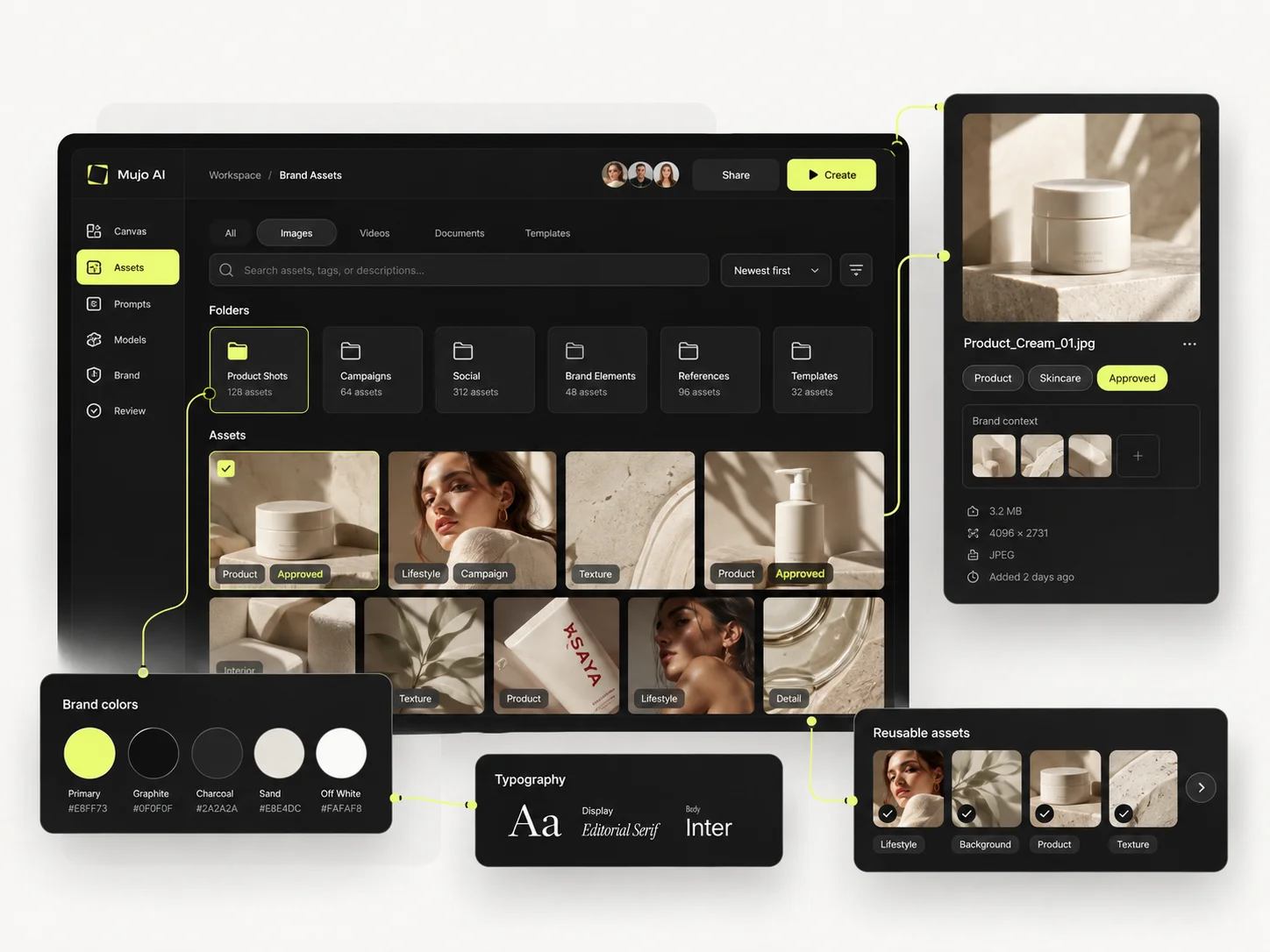
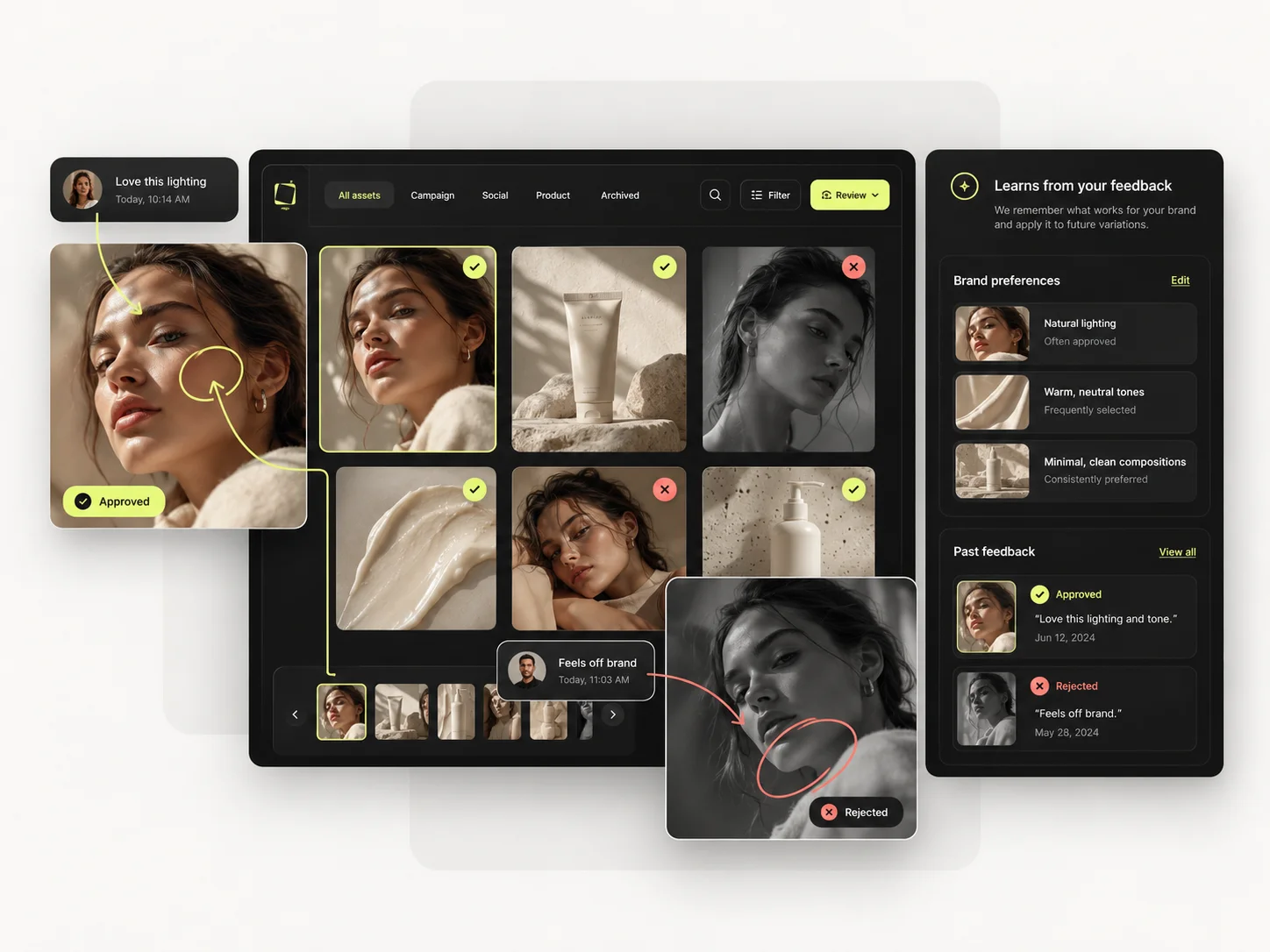
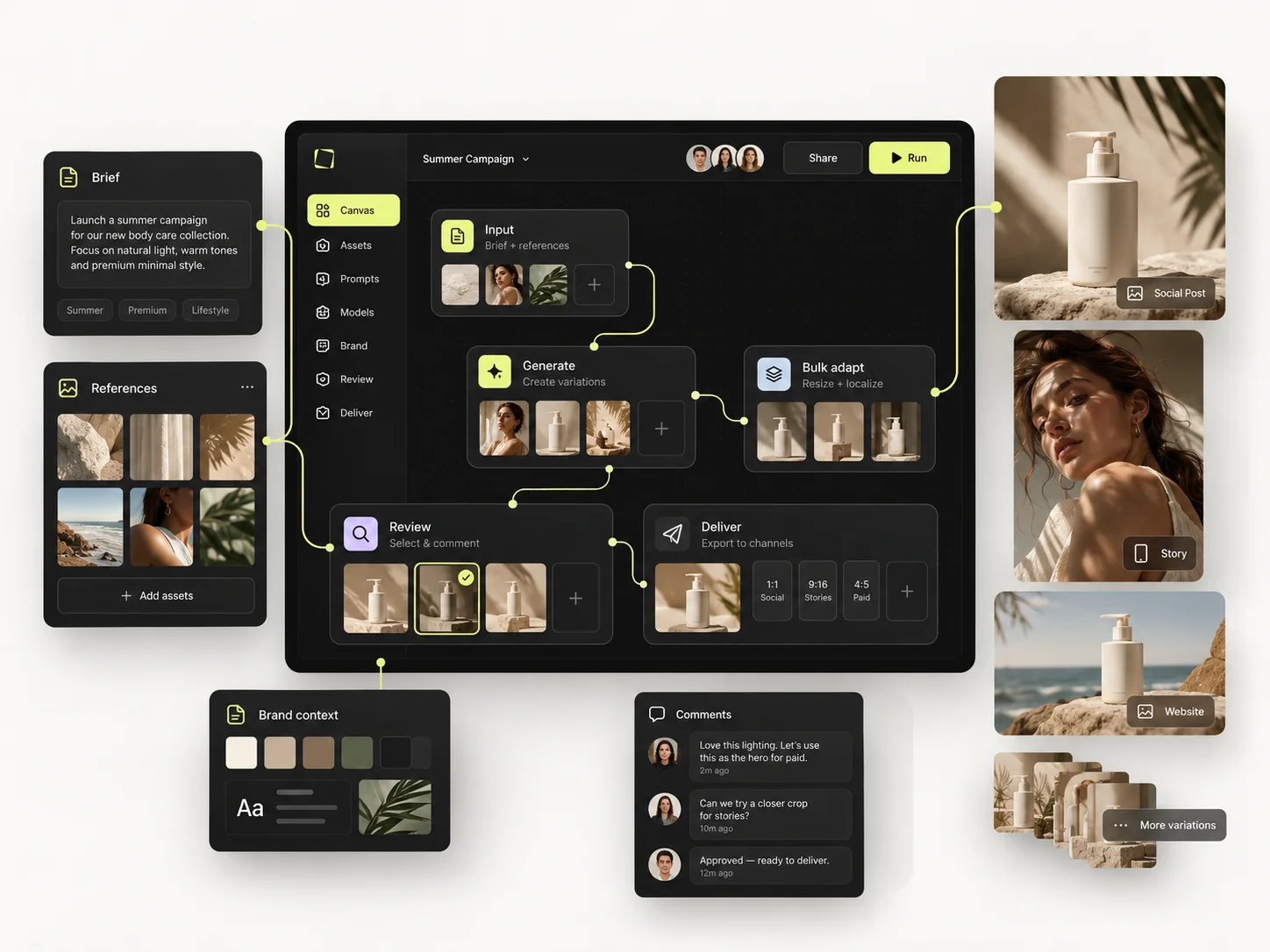
Prompts behave as production assets: refined with structured controls, compared across models, saved to the Prompt Library. Selected workflows can be published — see Creative Portfolio Examples — so a good setup is findable by the team. Higgsfield takes a different route. Take one product photo and a short launch brief. The goal is to make a hero image, three square social variations, a vertical motion ad, and then recreate the same visual direction for a second SKU next week. Higgsfield can automate more of this end-to-end through Marketing Studio, Canvas, and Supercomputer, and it will usually offer more sophisticated motion treatment. Mujo keeps the path more explicit: save the prompt logic, Creative Controls choices, references, and Prompt Library; compare models; then reuse the successful system for the next SKU. Higgsfield's ceiling is higher for automation. Mujo's process is easier to inspect and reuse when the team wants a human-directed content system rather than an agent-directed production pipeline.
Saved setups live in the Prompt Library where the next person can find them, instead of in the generation history of whoever happened to get it right. Whatever you keep from a Higgsfield session, it is usually the output rather than the reasoning behind it.
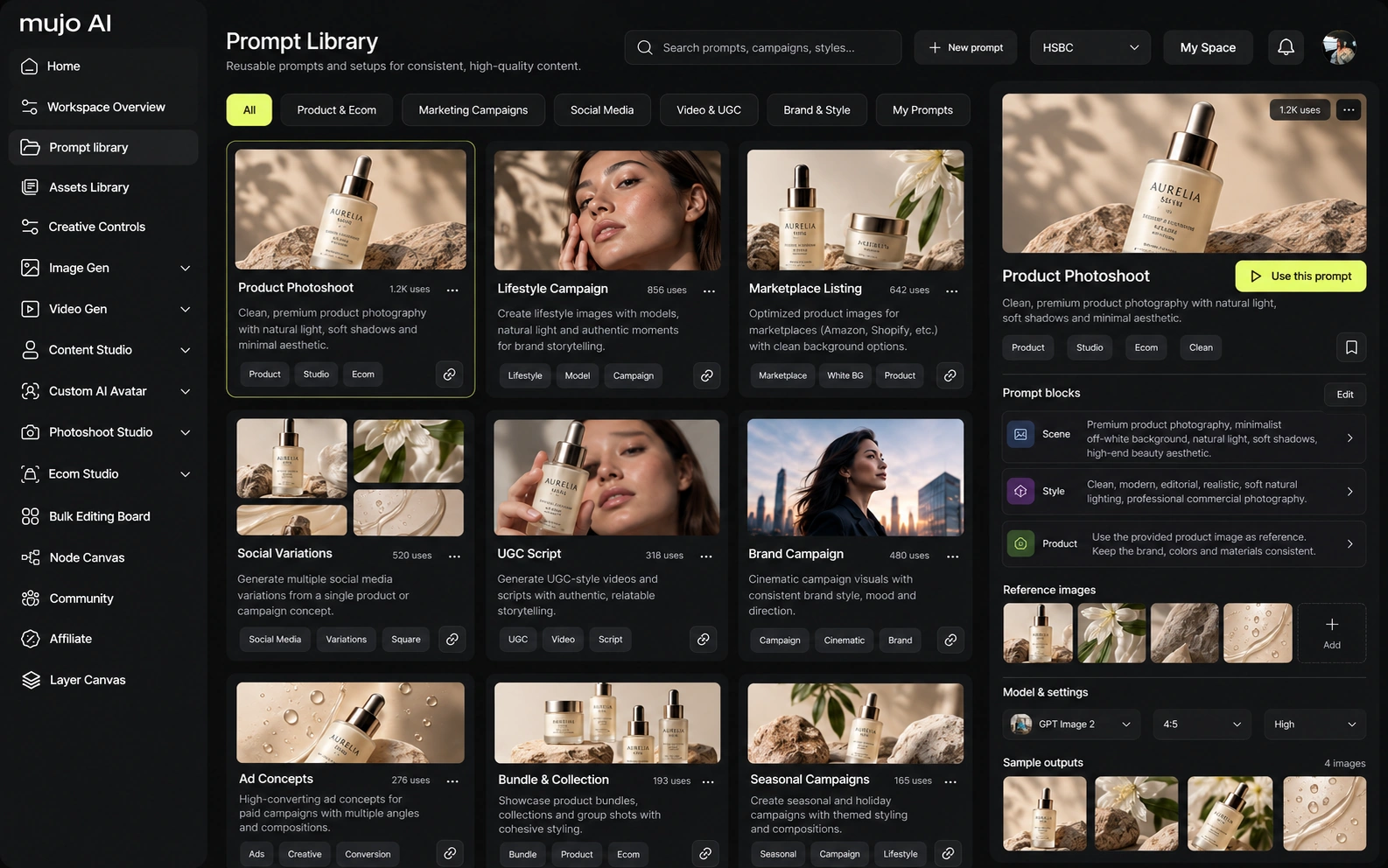
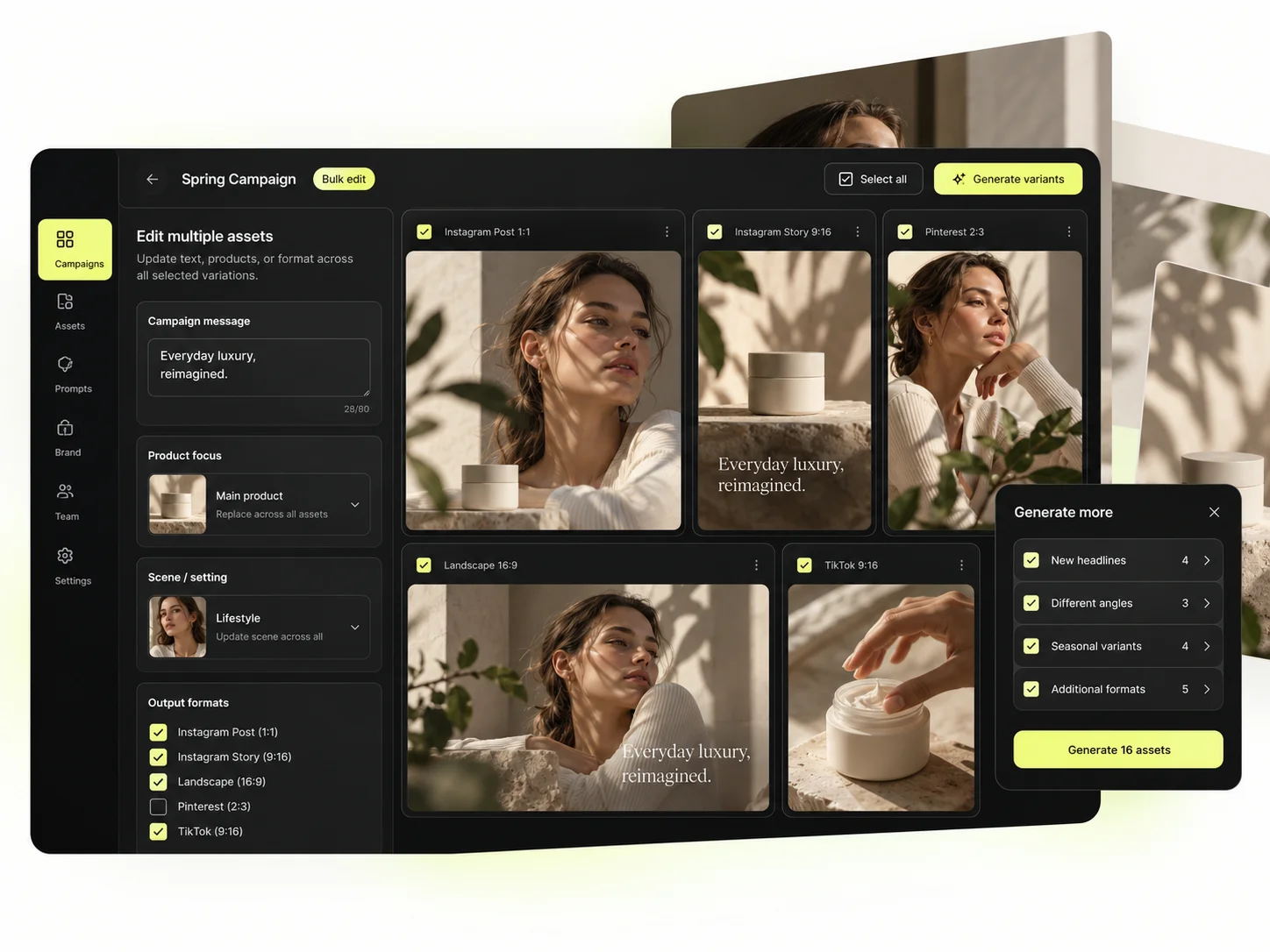
The Bulk production table is the unglamorous half of a campaign. Rows are assets, columns are the variables, and one approved direction runs down a product list. The hero shot gets the attention; these are the forty that ship alongside it.
Per-asset work scales linearly: forty products means forty sessions. A saved direction run in bulk does not. That is the line where a Higgsfield workflow and a Mujo workflow stop costing the same.
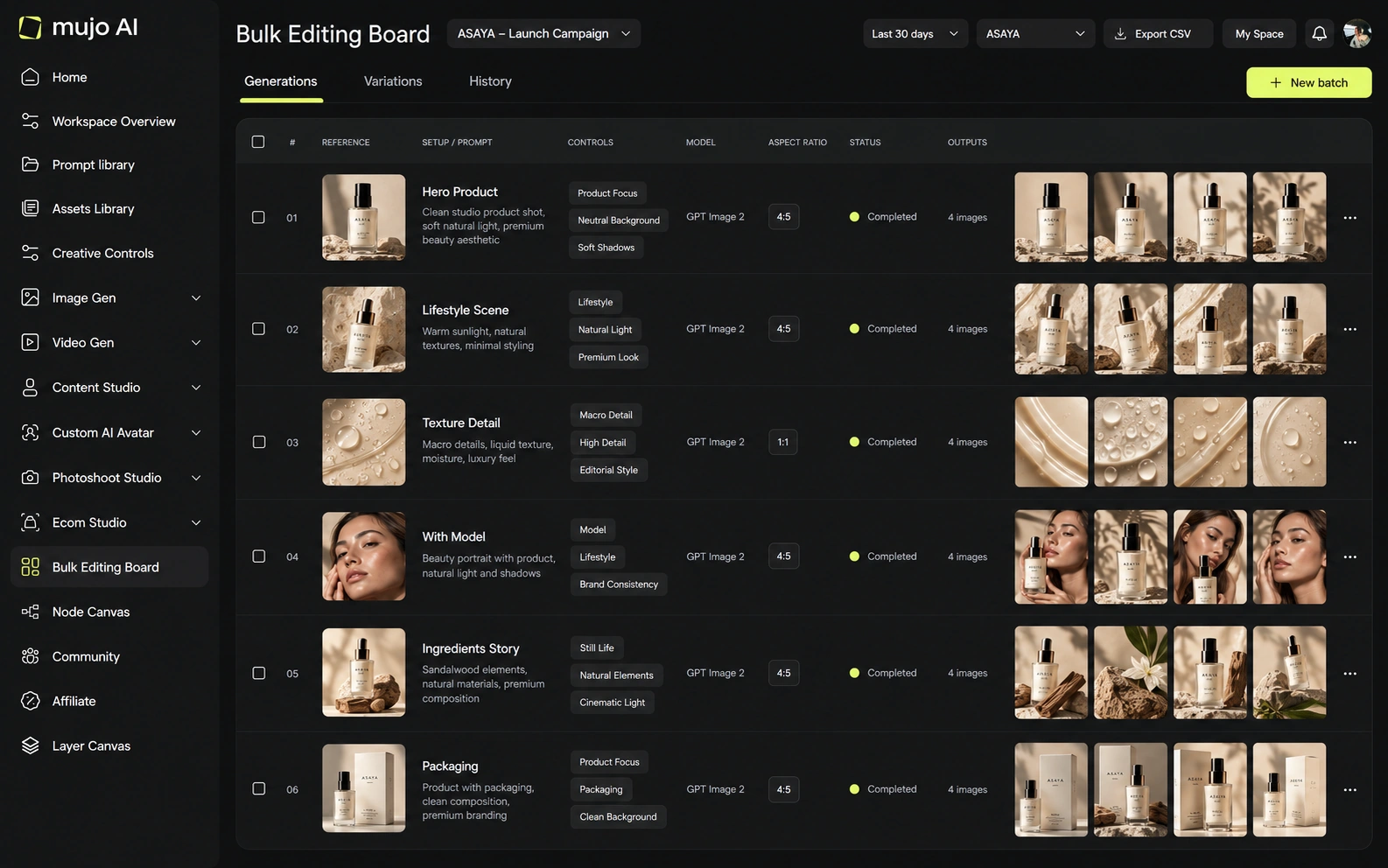
Run the same brief through both: one product image in, a hero visual, three square social variants and one vertical motion ad out — then the same direction on a second SKU a week later. Higgsfield will win the motion ad. Check the other five assets.
Start from one source product image and one launch brief.
Deliver the hero visual, three square cuts and one vertical motion ad.
Save the direction: prompts, references, controls and the video engine you chose.
Rerun the set on a second SKU from the saved setup.
Higgsfield clears the first round comfortably, as does almost anything else worth evaluating. The second round is where the difference appears, and it is the round nobody gets to during a two-week trial.
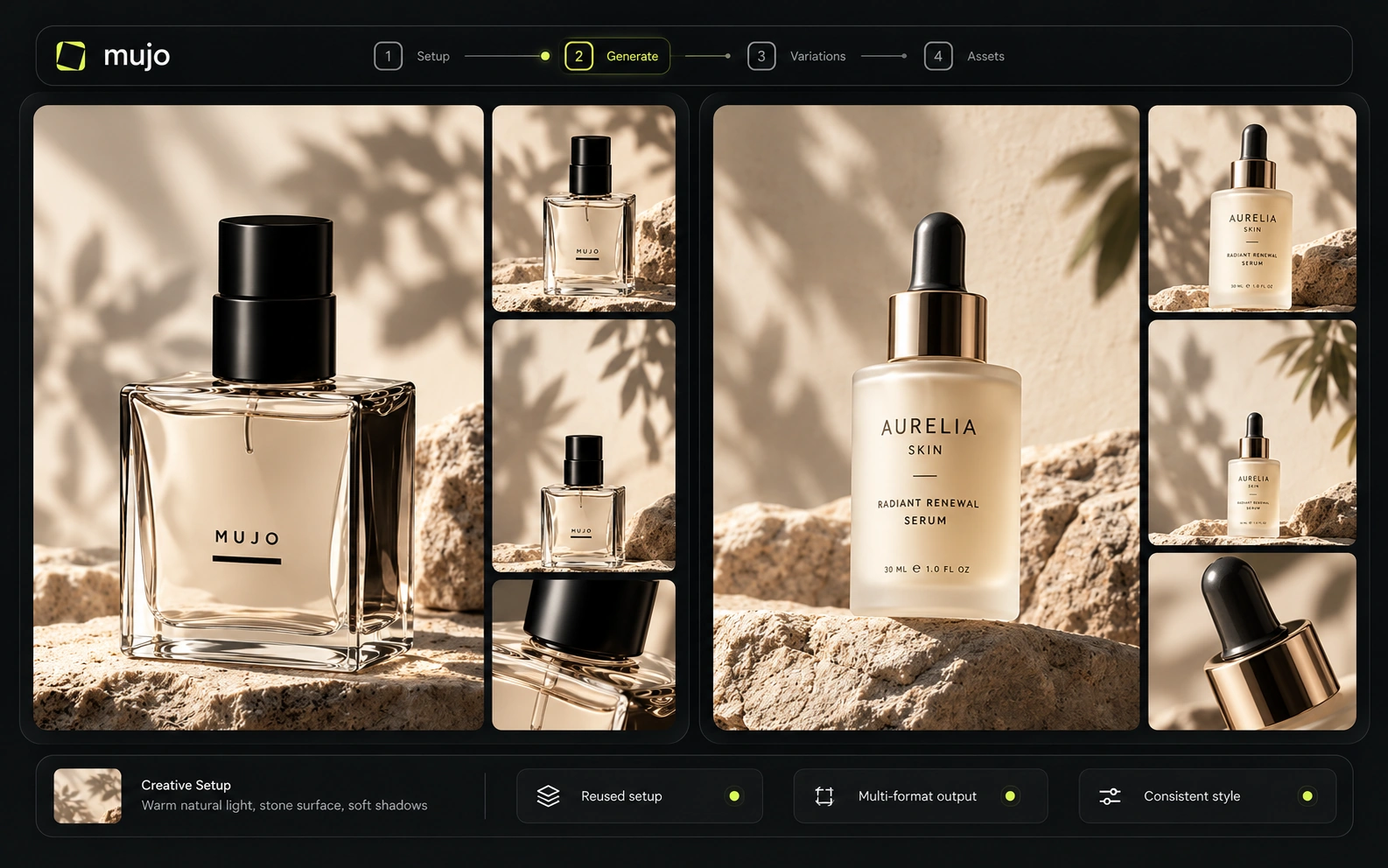
Higgsfield's Team, Scale, and Enterprise offerings support pooled credits, shared assets, role and spend controls, SSO at higher tiers, and dedicated enterprise capacity. Canvas supports collaboration, while plugins connect to Premiere Pro, After Effects, and DaVinci Resolve. Higgsfield also offers MCP, CLI skills, and a self-serve API. Mujo's enterprise proposition centers on reusable workflows, brand context, asset management, production traceability, and a Node Editor. Higgsfield currently has the more mature public developer and post-production surface.
Mujo Enterprise covers Node Editor flows, brand context, shared prompt and asset libraries, approval traceability, onboarding, admin and security review — the operational half. Higgsfield's investment goes into the creative half, and the split is visible in both products. If an API matters, verify models, concurrency and pricing on both sides. If the work is in the interface, shared setups are the thing to compare.
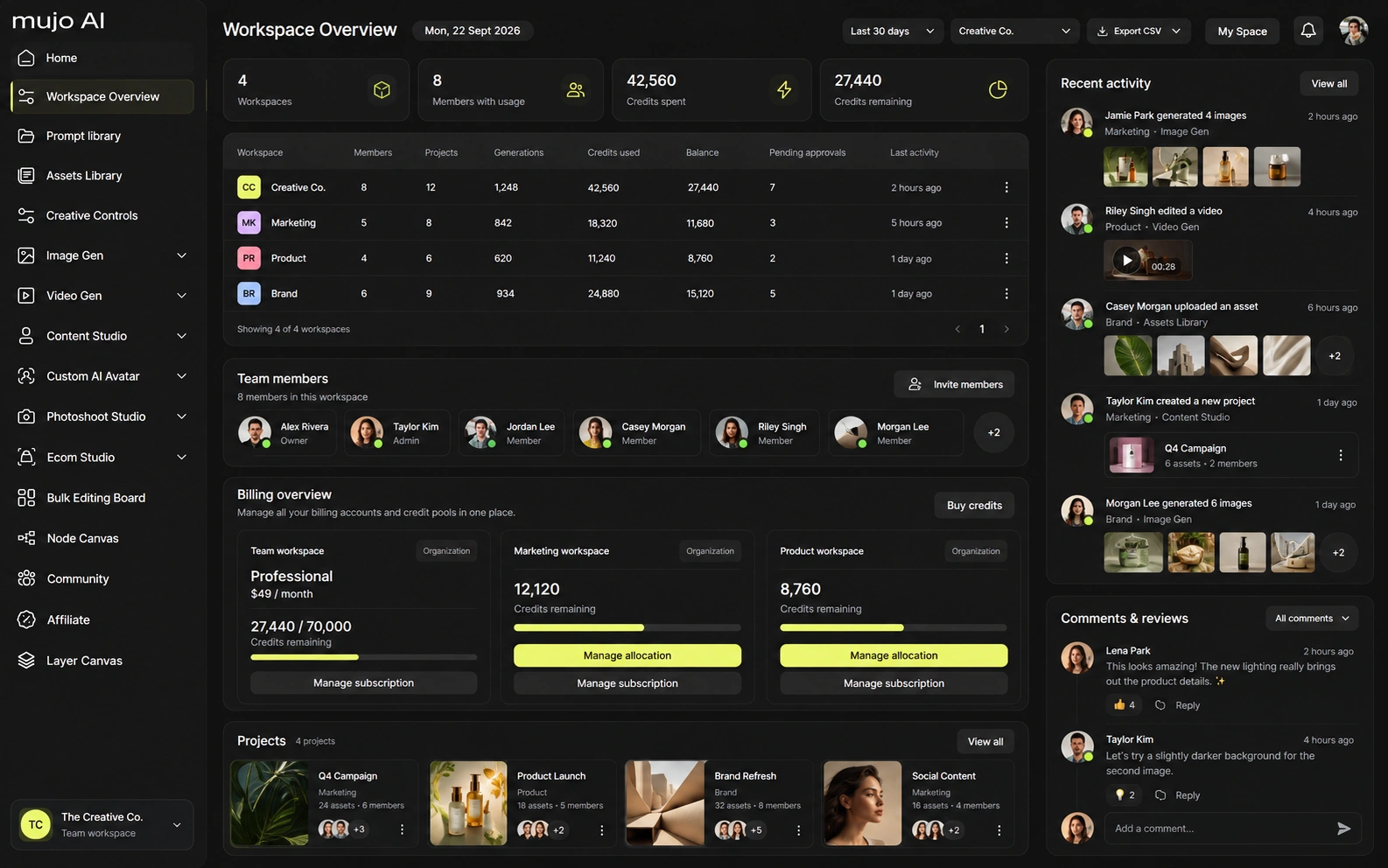
Higgsfield subscription credits reset rather than rolling over, and one-time credit packs require an active subscription and expire 90 days after purchase. Its API is separate: it has no subscription, uses a USD balance, starts with a $5 minimum top-up, and publishes per-generation rates. Higgsfield also sells selected unlimited access on some plans/add-ons, so a headline 'cost per credit' is not a complete cost comparison. Mujo's public credit purchase is simpler for irregular use because the pricing page states that purchased credits can be used at any time.
200 credits/month
USD balance; 50+ models; no subscription
Plans Start $9, Basic $19, Pro $34, Creator $84, Business $121 (5 seats); 200-credit packs from $2.60 with no use-by deadline
50 credits on current product pages
Mujo's plans run from $9 to $121 a month, with up to 40% off on annual billing. Pay-as-you-go packs start at 200 credits for $2.60, credits carry no use-by deadline, and new accounts start with 20 free. Video pricing only compares at matched model, resolution and duration.
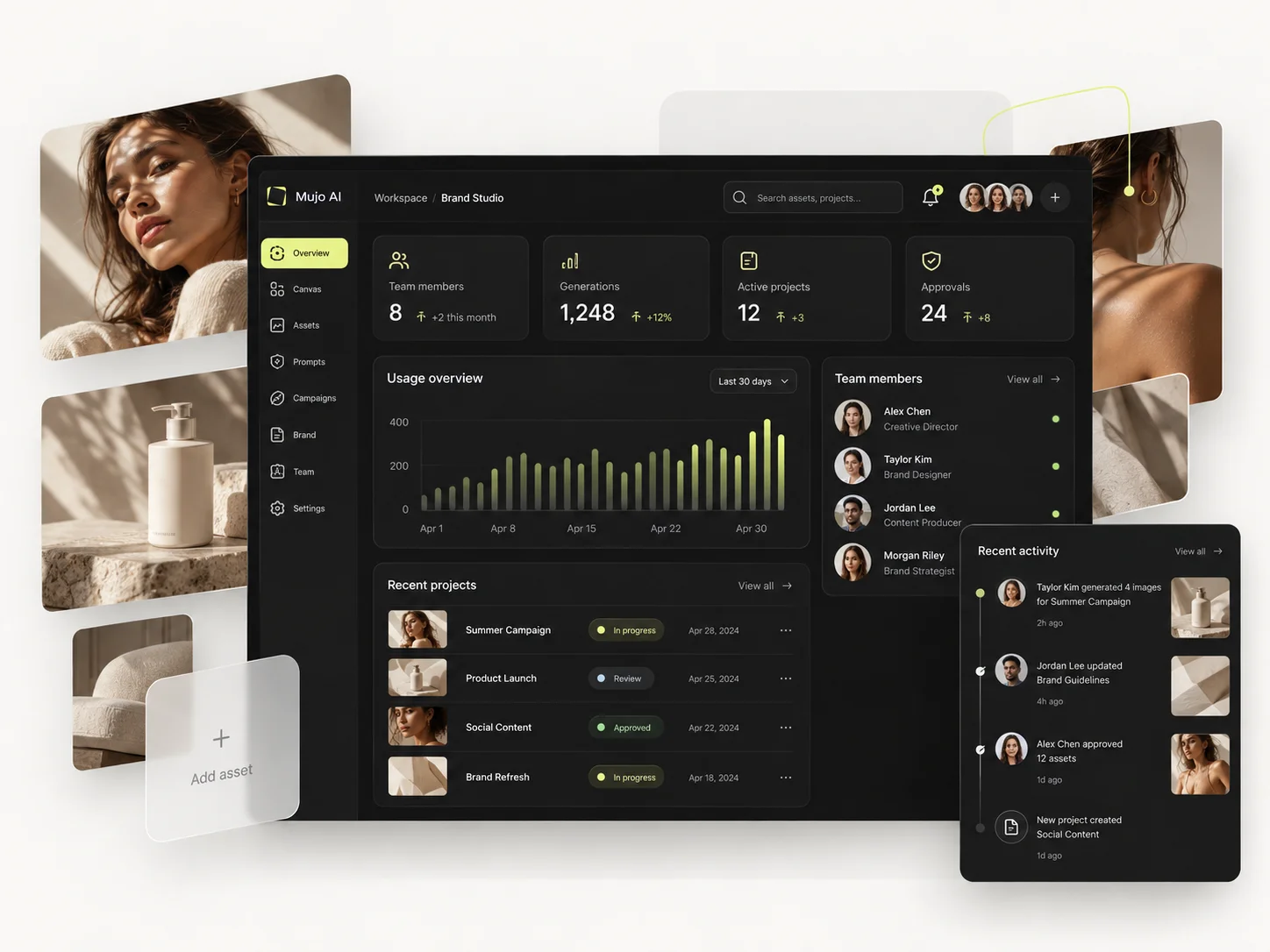
Higgsfield has business plans and an enterprise layer designed for team production. For sensitive brand work, compare the exact enterprise data terms and third-party model routing you intend to use. Mujo publicly states that user inputs/outputs are not used to train foundation models without opt-in and that enterprise uploads, prompts, references, and generations are not used to train Mujo or third-party models in its stack.
Specifically, on Mujo's side: users keep ownership of what they upload and of AI-generated outputs and may use those outputs commercially, subject to applicable law and third-party rights; inputs and outputs are not used to train foundation models without opt-in, and the enterprise terms extend that to the third-party models in the stack. Commercial-use permission is not rights clearance. Trademark, publicity rights and model-provider terms still apply, so client work needs human review before it ships.
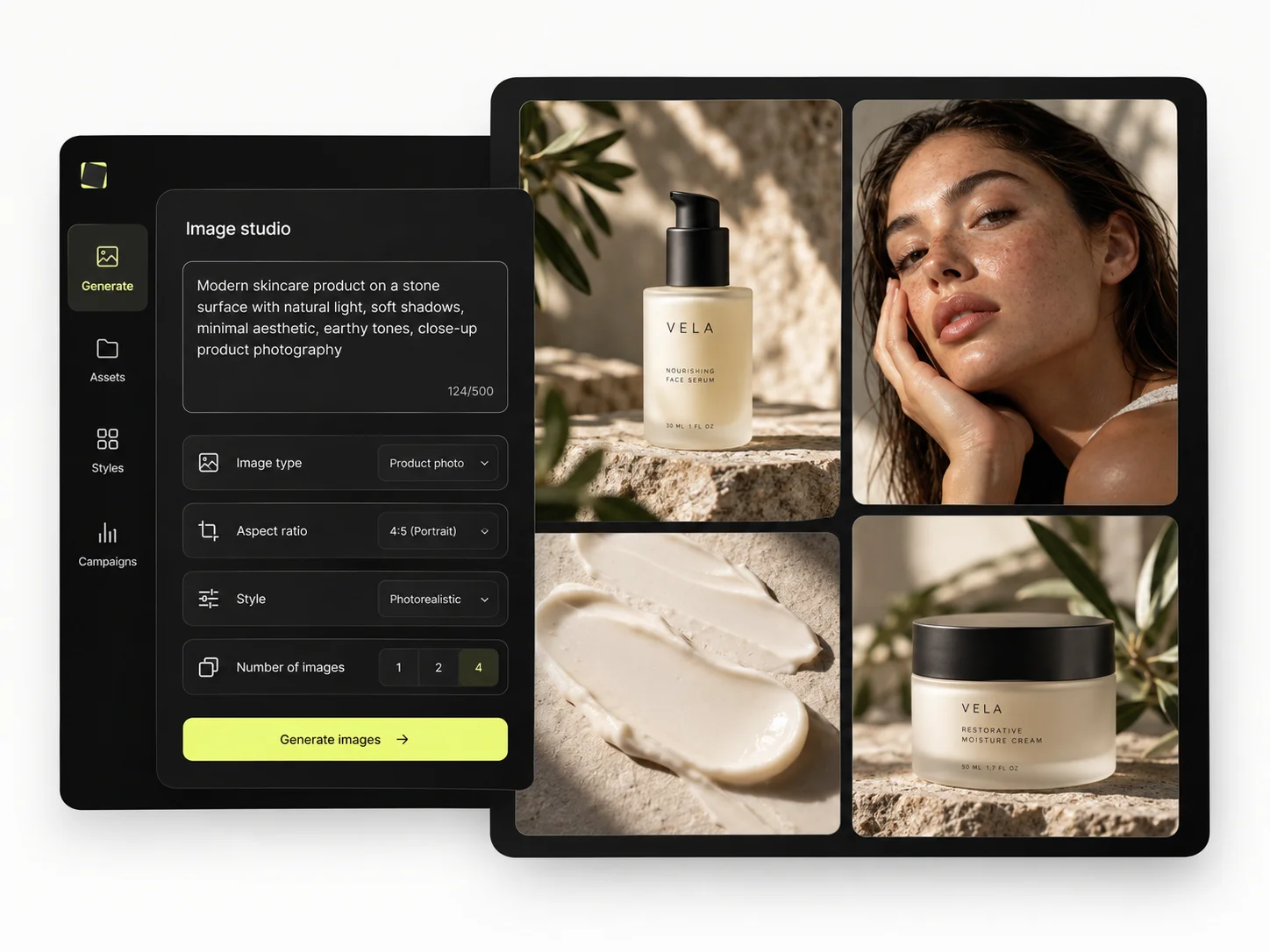
What Higgsfield does better, and what Mujo does better. A comparison page that only fills in one side is not a comparison.
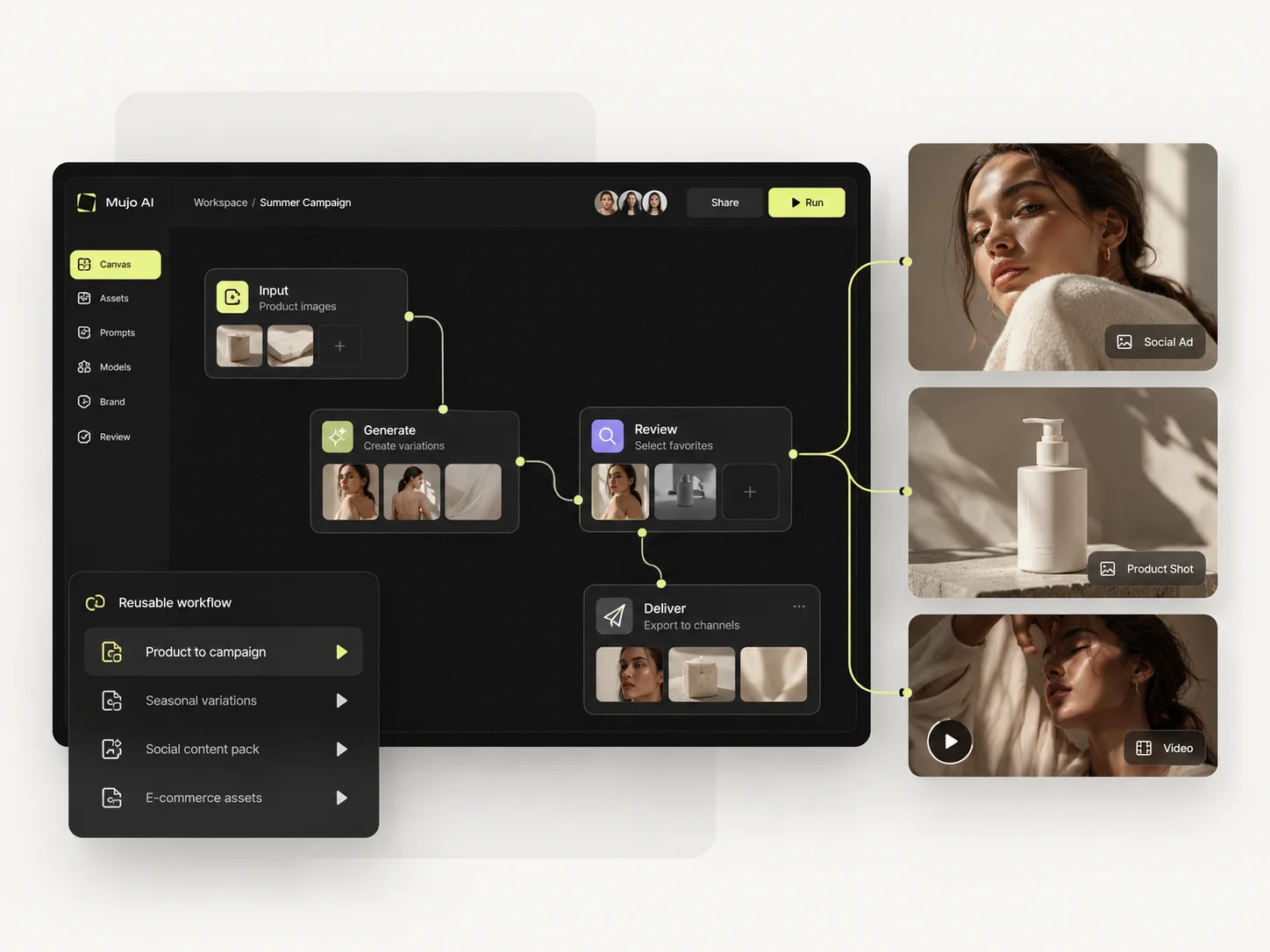
Worth reading before a trial rather than after one.
The overlap between the two platforms is growing, but their center of gravity is still different. Higgsfield is becoming a sophisticated video-and-ad production operating system. Mujo is building a reusable content operating layer around models, prompts, references, product workflows, and creator assets. A brand producing large volumes of cinematic paid social may prefer Higgsfield's deeper automation and motion stack. A team that wants its winning creative logic to remain reusable across models and formats will find Mujo easier to standardize.
Choose Higgsfield when the highest-value deliverable is cinematic video, UGC-style video ads, multi-shot storytelling, recurring synthetic talent, or automated creative production.
Choose Mujo when your recurring problem is maintaining a reusable creative system across product images, listings, social assets, creator content, and multi-model experiments.
The pairing that works: Higgsfield for the hero motion piece, Mujo for the campaign it belongs to. Useful when the film is handled and the surrounding assets are what is late.
If the recurring deliverable is a shot, buy camera control. If it is a campaign with a shot in it, compare what survives from one campaign to the next.
Short answers about Higgsfield, about Mujo, and about the parts that are easy to get wrong.
Not completely. Mujo can generate and compare video through models such as Kling, Seedance, and Veo, but Higgsfield currently exposes deeper cinema-specific controls, multi-shot tooling, lip sync, audio, and agentic production.
Yes. Higgsfield's self-serve API provides access to more than 50 image and video models with pay-as-you-go USD billing.
Higgsfield is stronger when the ad is primarily a video-production problem. Mujo is stronger when the ad is one output inside a larger repeatable product-content workflow spanning images, listings, social variants, and reusable prompts.
Subscription credits reset. Higgsfield's one-time credit packs are valid for 90 days and require an active subscription.
Yes. A practical hybrid is to standardize creative directions and product-content systems in Mujo, then use Higgsfield for the campaigns that need advanced cinematic or agentic video production.
A comparison against Higgsfield stays abstract until you look at the work it is about. These are the production workflows Mujo is built around, plus the neighbouring comparisons if you are still shortlisting.
Take a brief to a full set of campaign assets in one workspace.
Turn one approved creative into controlled versions across formats and markets.
Run an approved product direction across a whole SKU list.
Licensed footage against generated production.
Editing depth against repeatable sets.
A developer API against a finished interface.
If the hero video is fine and the forty supporting assets are the problem, that is the half Mujo was built for. 20 free credits. Rebuild a campaign you already shipped and time the second SKU.