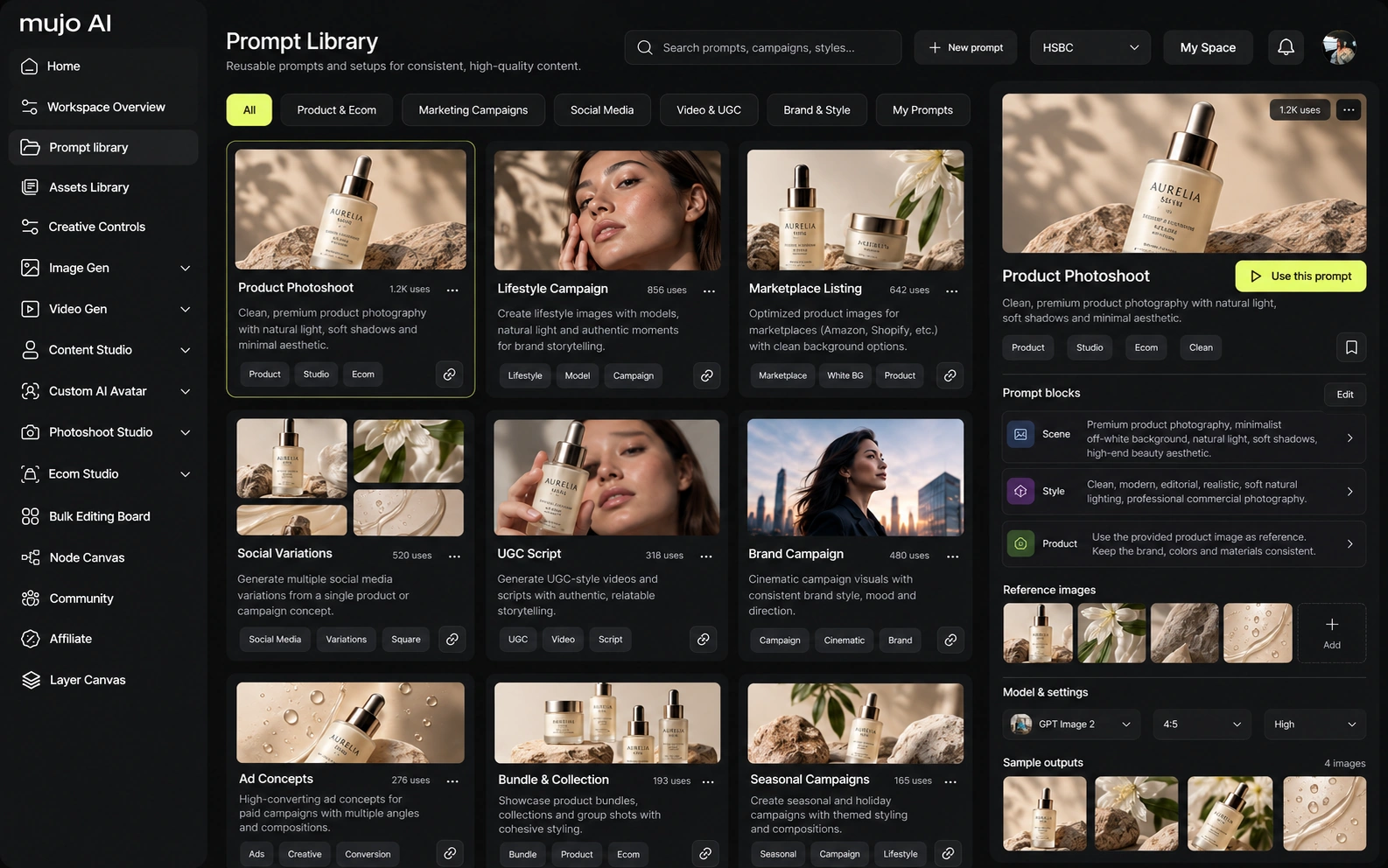
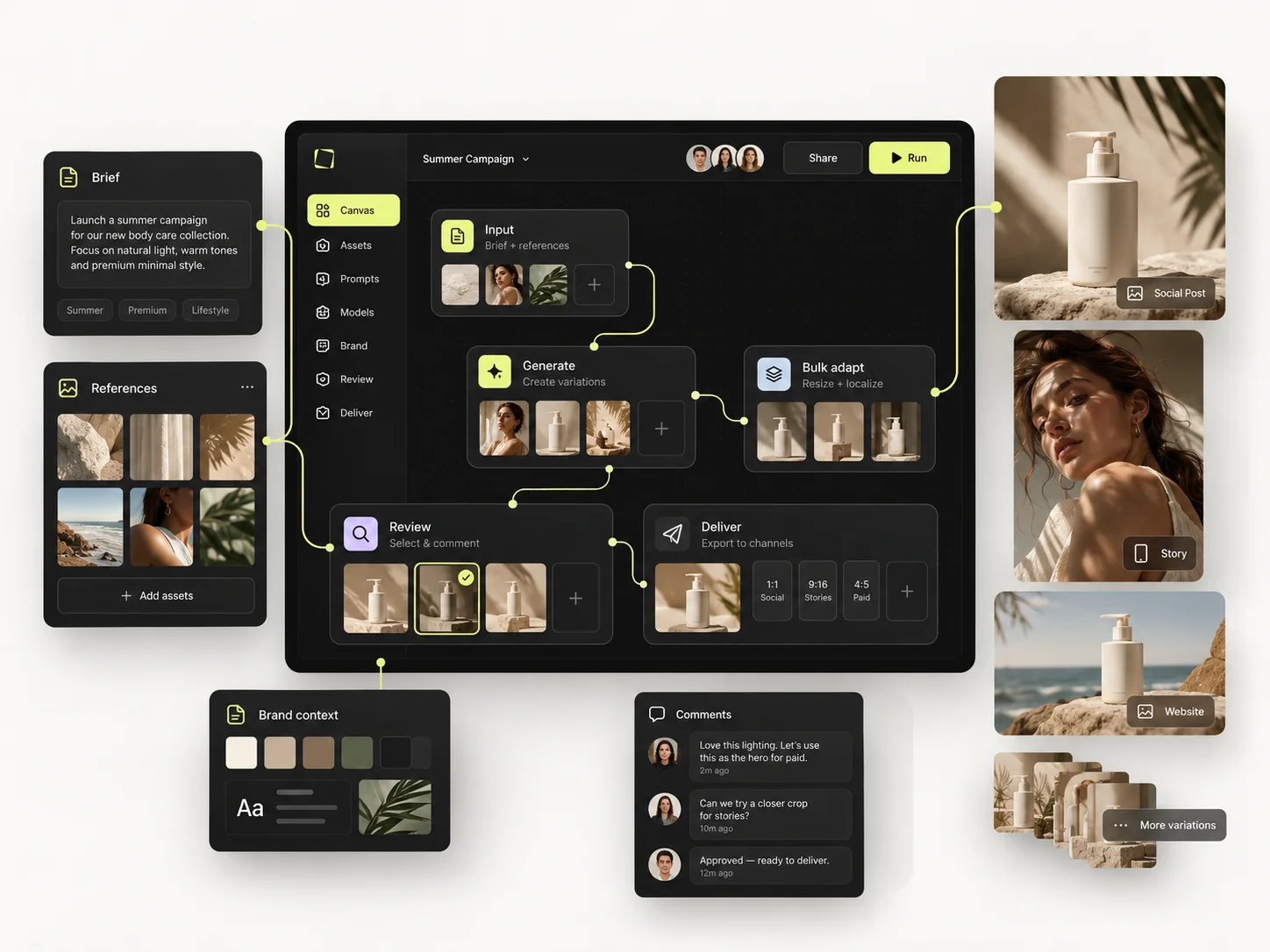
Standardising AI creative production across an agency means agreeing four things once — how a client account is structured, what has to be saved before work starts, what gets checked before delivery, and who can change an approved setup — and then applying them identically to every account. The aim is not uniform creative. It is that any team can pick up any account without starting from nothing.
Agencies feel this problem earlier and harder than in-house teams, for a structural reason: an agency is not one brand. It is eight, with eight sets of references, eight approved looks and a rotating cast of people working across them.
This guide covers the account template, the definition of done, the QA pass and the permission split — the four standards that carry an agency from "one designer who is good at AI" to a capability the agency owns.
The short version
- One workspace per client, structured identically — that is the whole foundation.
- Define what must exist before production starts: references, approved look, cast.
- Write a QA checklist. Four items beats a culture of carefulness.
- Standardise the container, not the creative. Every account looks different inside.
- A standard nobody can follow in a hurry is not a standard.
Why agencies need this more than in-house teams
An in-house team standardises around one brand and can get surprisingly far on shared habits. Agencies cannot, for four reasons that compound:
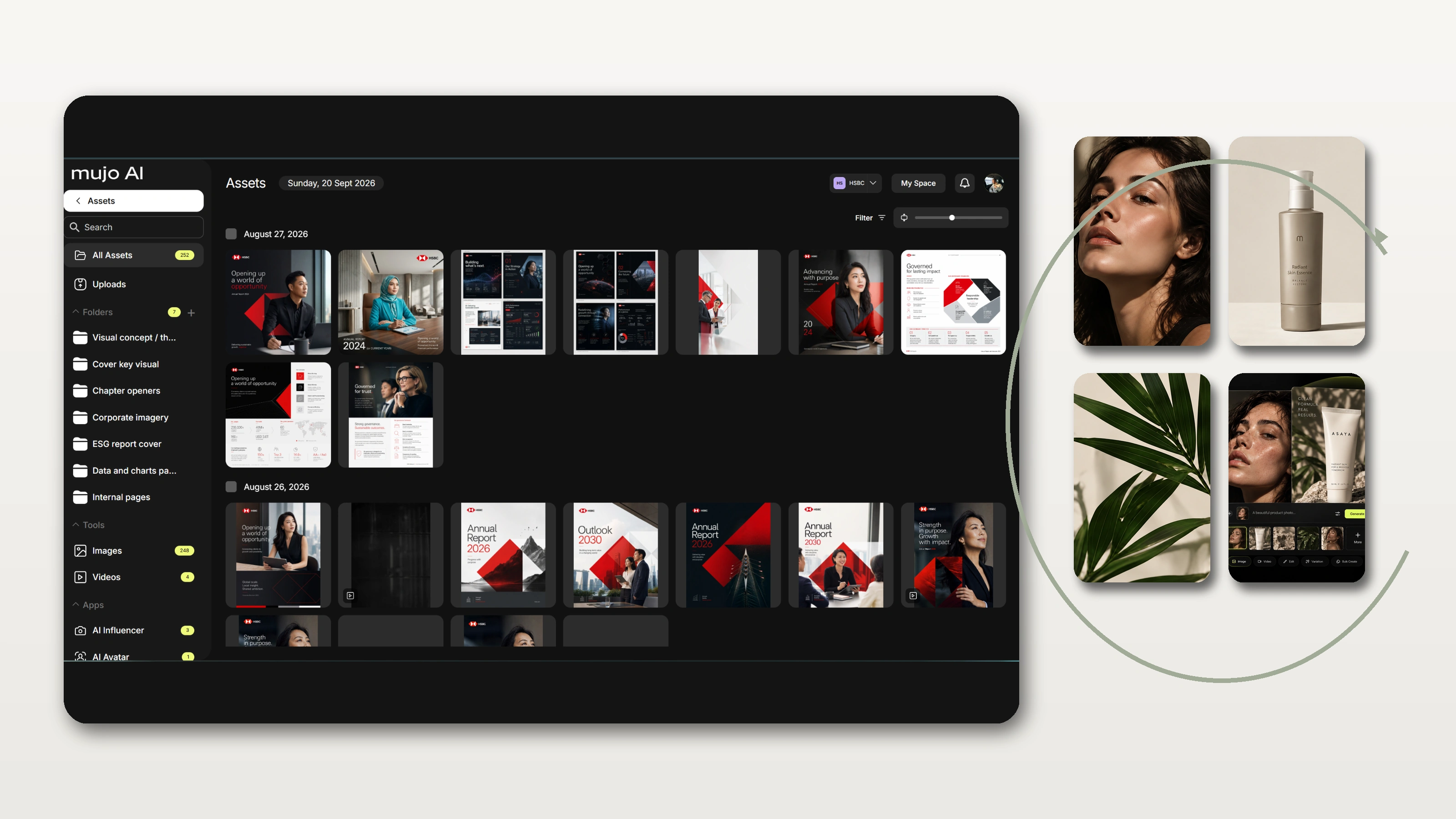
- Many brands — each with its own look, references and rules.
- Rotating staff — freelancers, juniors, people moved between accounts mid-campaign.
- Client separation — one client's assets must never surface in another's work.
- Billing — you need to know what an account consumed.
None of those are solved by better prompting. They are solved by structure, which is the unglamorous thing agencies tend to skip while chasing capability.
Standard one: the account template
Every client account gets the same structure. Identical, boring, and the reason someone can be moved onto an unfamiliar account on a Tuesday and be useful by Wednesday.
One rule above all others: no shared assets between client workspaces. A character created for one brand does not appear in another's campaign. This is both a commercial hygiene issue and a rights one, and it only holds if separation is structural rather than a matter of remembering.
Standard two: the definition of ready
Agencies lose more time to starting work before the inputs exist than to any generation problem. Fix it with a short list of what must be in the workspace before production begins:
- Real product references — photographs, not descriptions.
- An approved look — saved as creative controls, not as a mood board.
- The cast, if people appear — saved AI characters rather than described per image.
- The output list — formats, markets, quantities, agreed with the client.
- A named approver — one person, client-side, who signs off.
If any of the five is missing, production has not started — someone is guessing. Making this explicit turns an awkward conversation about readiness into a checklist item, which is much easier to have.
Standard three: the QA pass
Every agency believes it checks work carefully. Very few have written down what checking means, which is why the same four errors keep reaching clients.
Product accuracy
Shape, colour, proportions and materials against the real product. The client knows their product better than you do and will spot a wrong cap in two seconds.
Text, logos and packaging
At full size, not in a thumbnail grid. Generated small text is unreliable and this is the single most common reason an asset cannot ship.
Brand consistency across the set
Review by dimension — all of one product together, all of one market together. Drift shows up as a group and hides in a list.
Language and market fit
Anything rendered in a language your reviewer does not read goes to someone who does. Every time, no exceptions, before delivery.
Four items. Short enough that people actually run it on a Friday afternoon, which is the only test a checklist has to pass.
Standard four: who can change what
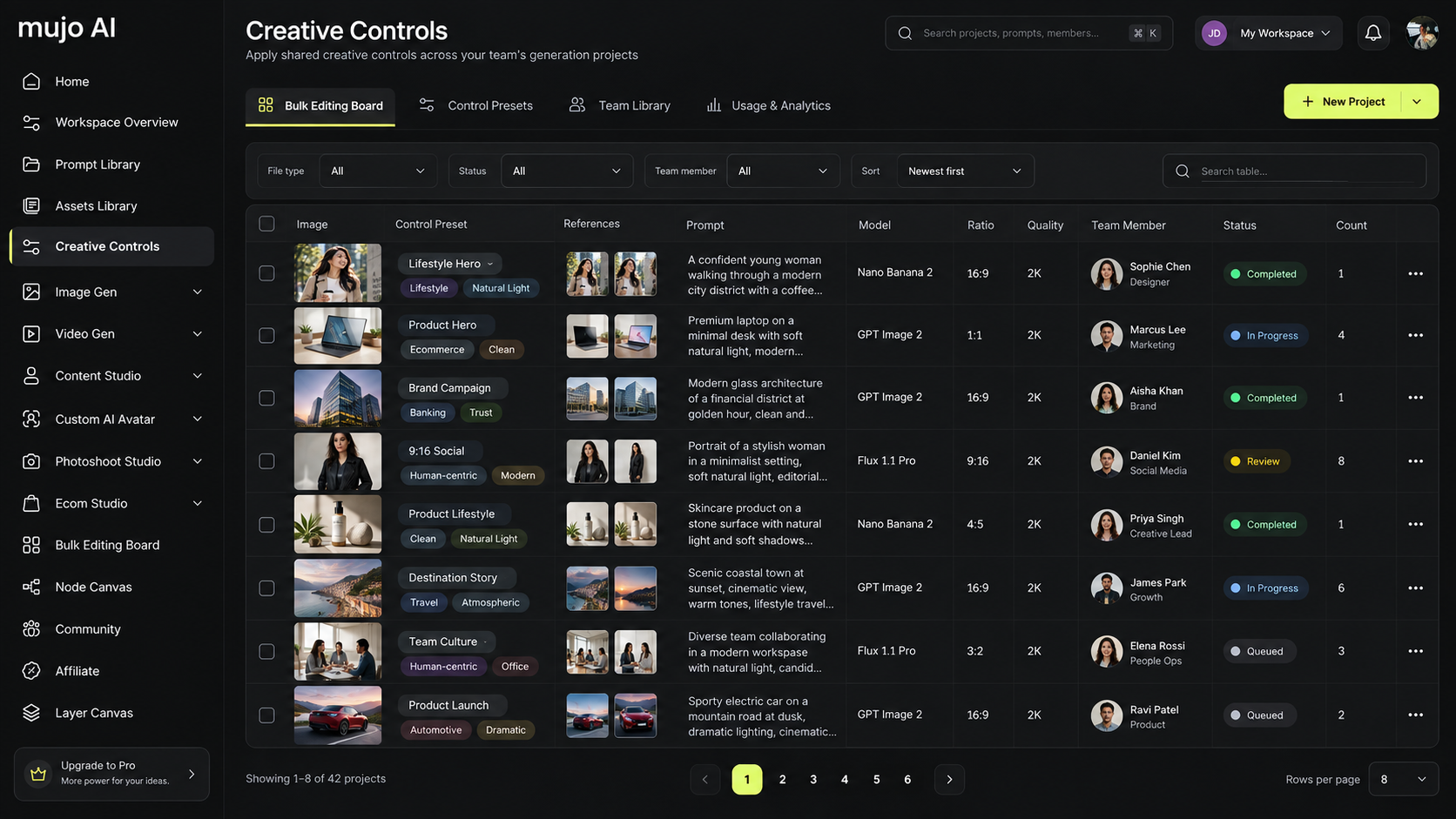
The permission split that matters is between producing with an approved setup and changing it. Bundle them and you get one of two failures — either everyone can edit the client's approved look, or only the art director can produce anything.
In an agency the mapping is usually:
- Account lead / art director — can change the approved look and workflows.
- Designers and producers — can produce using them, cannot change them.
- Freelancers — production access, scoped to one client workspace only.
- Client reviewers — view and comment, nothing more.
This is what lets you put a freelancer on an account on Monday without a conversation about what they might break. Confirm which roles and external-access features exist on your plan before designing a process around them — see Team Workspace.
Onboarding: the real test of a standard
A standard is only real if a new person can follow it without being taught. The test: can someone who joined on Monday produce a correct asset for an unfamiliar account by Wednesday?
If yes, you have standards. If no, you have habits. What makes the difference:
- Identical structure across accounts, so learning one teaches all.
- The approved look loaded by default rather than reconstructed.
- Workflows named for what they do, not "final_v4".
- A written QA list rather than a culture of carefulness.
What usually goes wrong
Standardising the creative instead of the container
Agencies sometimes standardise so hard that every client's work starts to look the same — which is the one outcome a client will actually notice and object to. Fix: structure, process and QA are identical; the creative inside is different for every account.
The one AI person
Capability sits with one enthusiast, and when they are busy the agency has no AI capability at all. Fix: a standard that others can follow is the only way capability moves from a person to the agency.
Assets leaking between clients
A character or reference created for one brand reused on another because it was to hand. Fix: structural separation, and treat it as a hard rule.
Standards written once, never applied
A thorough document from March that nobody has opened since. Fix: put the standard in the account template and the saved setup, where it applies itself, rather than in a deck.
Frequently asked questions
How do you standardise AI creative production across an agency?
Four standards: an identical account structure per client, a definition of what must exist before production starts, a written QA checklist, and a permission split between producing and changing a setup.
Does standardising make all our clients' work look the same?
Only if you standardise the wrong layer. Structure, process and QA should be identical; the references, approved look and cast are unique per account, so the output differs as much as the brands do.
How do we keep client assets separate?
Separate workspaces with their own libraries and access lists, not folder conventions. No character, reference or setup crosses between accounts.
How do we onboard freelancers quickly?
Identical account structure plus production-level access scoped to one client. They learn the structure once and can work on any account that uses it.
What belongs in an AI QA checklist?
Product accuracy against the real item, text and packaging checked at full size, brand consistency reviewed by dimension, and language checked by a native reader. Four items, short enough to actually use.
Can we track what each client account costs?
Usage visibility per workspace is what makes this possible. Confirm the reporting available on your current plan before building client billing around it.
Where should an agency start?
With the account template. Everything else — QA, permissions, onboarding — depends on accounts being structured the same way, so it is the one to do first.
Standardise the container, not the creative
The agencies that scale AI are not the ones with the best prompts. They are the ones where every client account looks the same from the inside, so any team can work on any account and the work still comes out right.
Four standards, each of which fits on a page. The creative stays as different as your clients are — which is, after all, what they are paying for.
One system. Every client account.
Separate workspaces, shared standards, reusable setups and review built for agency production.