Going from a campaign brief to 500 creative variations is not a generation problem — it is a multiplication problem. You approve one master creative, then multiply it across a defined number of products, markets, formats and creative angles, and 500 is simply what those numbers come to. The work is in deciding the dimensions, not in producing the files.
Five hundred sounds like a vanity number until you count a real campaign: eight products, four markets, five placements, three creative angles. That is 480 before anyone asks for a seasonal version.
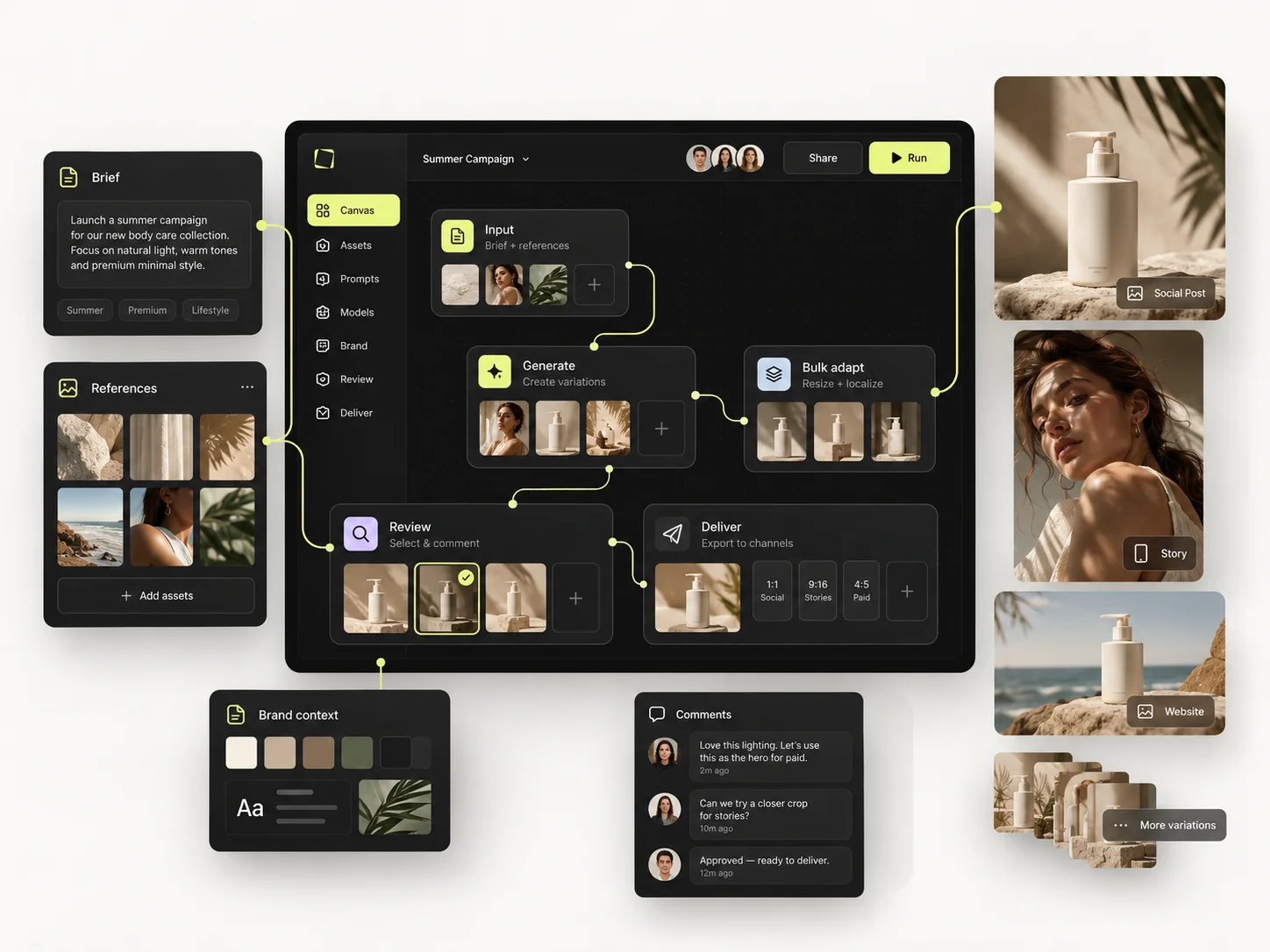
This walkthrough follows one campaign end to end — brief, concepts, master creative, variation matrix, production, review, delivery — with the arithmetic at each stage and an honest account of what takes the time.
The short version
- 500 is four dimensions multiplied, not 500 decisions.
- Everything depends on one approved master. Spend the time there.
- Build the whole matrix as rows before generating anything.
- Test 8 rows, fix the setup, then run the rest.
- Review is the longest stage. Budget for it or it becomes the bottleneck.

Where 500 actually comes from
Before anything else, do the multiplication. Most teams discover their number is either far smaller than feared or far larger than planned.
Notice what this reveals. Removing one market drops the campaign to 375. Cutting one creative angle drops it to 400. Scope decisions are multiplicative, and they are much cheaper to make now than after 200 assets exist. This table is the single most useful thing to put in front of a client at kick-off.
Stage 1: The brief and the references
Everything downstream inherits four inputs: the product, the visual direction, the casting and the mood. A vague brief does not get less vague when multiplied by 500 — it gets 500 times more expensive.
Gather real reference material rather than descriptions. A product photograph beats a paragraph about the product, every time, and it is the difference between generating a bottle and generating your bottle.
Stage 2: Concepts — explore before committing
Generate several distinct creative directions for the same brief and compare them side by side. Three to five is usually right; beyond that you are avoiding a decision rather than informing one.
This stage is cheap relative to everything after it, which is exactly why it deserves real attention. Approving the wrong direction here is the only mistake on this list that costs the whole campaign.
Stage 3: The master creative
One direction is chosen and taken to finished quality. This single asset is what all 500 inherit — the light, the composition, the treatment, the product rendering.
Spend disproportionate time here. An hour spent improving the master improves 500 outputs; an hour spent fixing output 314 improves one.
Save everything at this point: the creative controls, the references, the character if there is one. That saved bundle is the production setup for the rest of the campaign.
Stage 4: Build the matrix as rows
Now turn the dimensions into a production table — one row per intended output, one column per variable. Build the whole thing before generating anything.
Three things surface immediately at this stage, and all three are cheap to fix here:
- Combinations nobody wants. Not every product needs every angle in every market. A 500-row grid usually has 60 rows that exist only because the maths produced them.
- Missing combinations. The market somebody forgot, discovered now instead of at delivery.
- Rows whose settings drifted. Visible in a table; invisible in a folder.

Stage 5: Test eight rows
Never launch 500. Pick eight rows that cover the hardest cases — the tightest format, the darkest scene, the product with the most packaging text, the market with the longest word.
Check them against the master:
- Does the product stay accurate?
- Does the composition survive the extreme formats?
- Is packaging text correct?
- Does the lighting match across all eight?
A problem that appears in the test batch is a setup problem. Fixing it costs minutes now and an afternoon plus fresh credits later. This stage is the entire reason the method works at 500 rather than collapsing.
Stage 6: Run the rest
With the setup validated, run the remaining rows in Bulk Editing. Generation jobs consume credits, so a run of this size is worth planning as a run — see the budgeting arithmetic in stage 8.
If the campaign structure repeats — and campaigns usually do — the sequence behind this run is worth building once as a reusable node workflow, so the next campaign starts from a process rather than a blank canvas.
Stage 7: Review — the stage everyone underestimates
Here is the honest part. Generating 500 assets is the fast stage. Reviewing 500 assets is the long one, and teams that plan a timeline around generation speed are always late.
Make it survivable:
- Review by dimension, not by file. All 25 of one product together; all 100 of one market together. Drift shows up as a group, not individually.
- Three buckets: approved, needs adjustment, rejected. No fourth category, no "maybe".
- Check text and packaging at full size. Thumbnails hide exactly the errors that matter.
- Have local-language assets checked by someone who reads the language. This is not optional, and it is not a job for whoever is available.
A shared workspace with comments attached to assets is what stops round four being emailed to someone still looking at round two. See Team Workspace.
Stage 8: Budget the whole thing
Four lines, in order:
- Credits per generation at your chosen model and quality.
- × 500 planned outputs.
- + the 8-row test batch.
- + a rejection allowance for rows needing a second pass.
The fourth line is the one that gets skipped. On a first campaign with a new setup, plan for a meaningful share of rows to be redone. On a setup that has run before, that number should be much smaller — and if it is not, the setup is the problem. Check current pricing for plans and credit allowances.
What usually goes wrong at 500
Scope set after production starts
A fifth market is added in week two and the matrix grows by 125 rows. Fix: settle dimensions at kick-off, with the multiplication visible to everyone approving it.
The master was approved too quickly
Everything inherits it, including its flaws. Fix: treat master approval as the campaign decision it is, not as a step on the way to production.
Review planned as a day
500 assets are not reviewable in an afternoon, and the person who tries will start approving at row 200. Fix: budget review properly and split it by dimension.
Market versions checked by the wrong person
Text rendered inside an image, in a language nobody on the reviewing team reads. Fix: a named local reviewer per market, before delivery.
Frequently asked questions
How long does 500 creative variations take?
The generation is queued work and depends on models and settings. In practice the master creative and the review stage take the most time — plan the timeline around those two, not around generation speed.
How do you keep 500 assets consistent?
By producing all of them from one saved setup rather than re-entering settings per batch. Consistency comes from the setup being reused, not from anyone's discipline.
Can this include video as well as images?
Both image and video generation are available, though supported controls differ by video model. Confirm what the workflow you pick can do before planning a large video run.
How many of the 500 will be usable?
It depends on the setup. A first run with a new setup produces meaningfully more rejections than a run on a proven one, which is why the test batch and the rejection allowance both exist.
Do we need all 500?
Usually not, and the matrix is where you find that out. A 500-row grid typically contains rows that exist only because the arithmetic produced them. Cut those before generating.
Is 500 assets unlimited generation?
No. Production is governed by credits, model availability and workspace limits. Volume describes the workflow, not an unlimited allowance.
Can the next campaign reuse this?
That is where the return is. The saved setup, the characters and the workflow all carry forward, so the second campaign of the same shape starts from a process instead of a brief.
Decide the dimensions, not the files
A 500-asset campaign contains about six real decisions: the direction, the master, and the four dimensions. Everything else is multiplication.
Put the multiplication on a table at kick-off, spend your effort on the master, test eight rows before running the rest, and budget the review honestly. Done that way, 500 is a production plan rather than a crisis.
One brief. The whole campaign.
Take an approved master creative to every product, market and format from one production table.