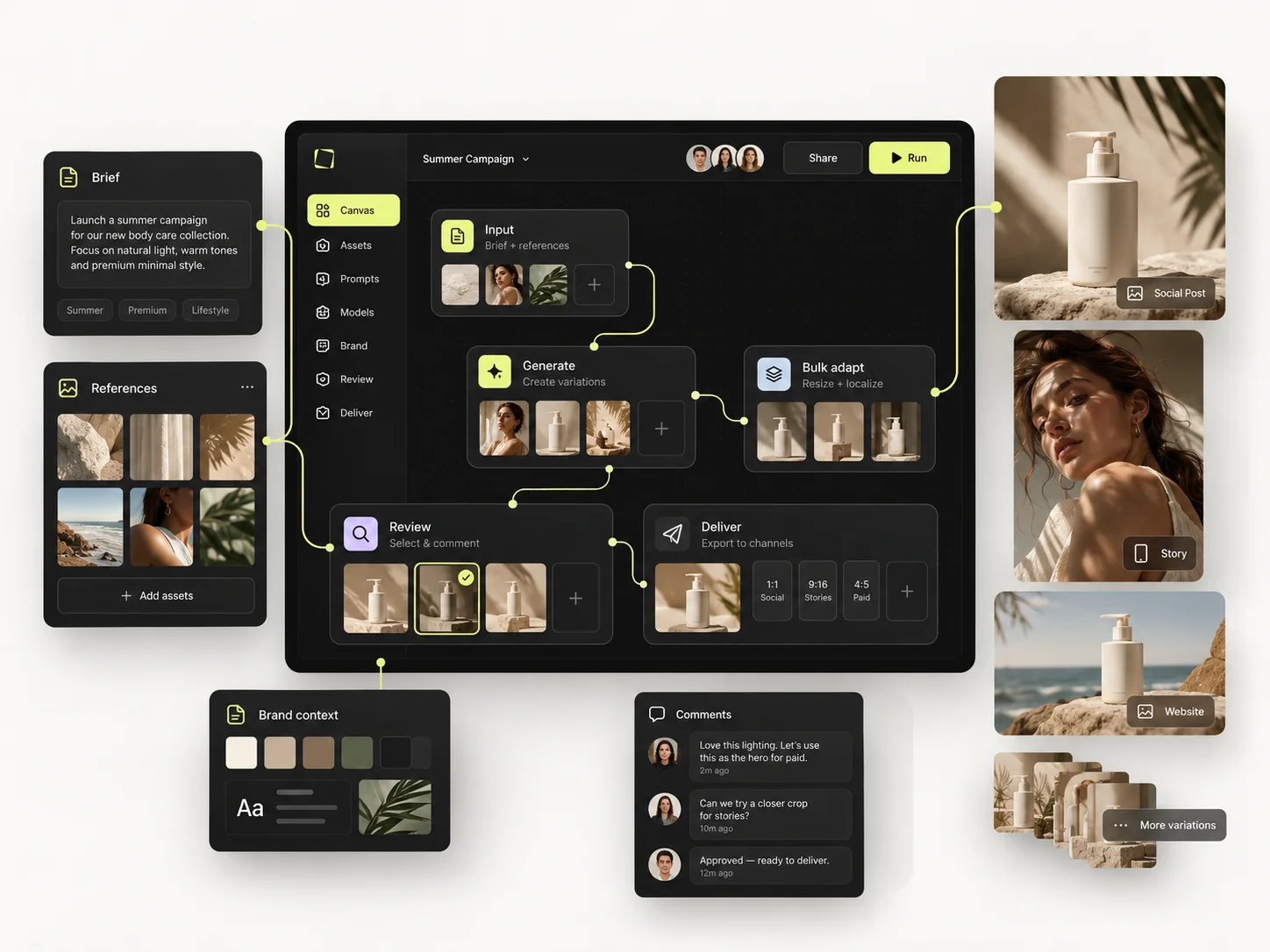
Running several AI subscriptions costs more than the sum of the invoices, because the real expense is fragmentation: assets scattered across accounts, output that does not match between tools, and no single place where a team's production process can live. Whether consolidating is right for you depends on one question — are you producing single images, or producing campaigns?
This is the question most creative teams reach about a year into using AI. It usually arrives as a finance question and it is not one. The subscriptions are rarely the expensive part.
This article compares the two approaches honestly, including the cases where multiple subscriptions are genuinely the better answer, and gives a way to work out which side of the line your team is on.
The short version
- The invoices are the small cost. Fragmented assets and inconsistent output are the large one.
- Multiple subscriptions are fine for one person exploring, and painful for a team producing.
- A platform absorbs model churn; separate subscriptions make every new model your migration.
- Consolidate before the asset library matters, not after.
- If your work is genuinely one-off and solo, stay where you are.

How teams end up with five subscriptions
Nobody decides to do this. It accumulates, and the path is always roughly the same:
- One designer subscribes to an image model for a project. It works.
- A second model is better at product shots, so that gets added.
- Video appears in a brief; a video tool gets added.
- Someone else joins and subscribes to what they already know.
- A year later there are five invoices, four asset libraries and no two people working the same way.
Each individual step was sensible. The outcome is not, and it is not a discipline failure — it is what happens when tools are adopted per task rather than per process.
The costs nobody puts on the invoice
Assets in four places
The product references are in one tool, the approved characters in another, last quarter's outputs on somebody's drive. When a new version of a campaign is needed, the work starts by finding things. That search cost recurs every project and appears in no budget line.
Output that does not match
Two people, two tools, one brief — and a campaign that looks like two campaigns. Consistency comes from shared references and shared settings, which is precisely what separate accounts cannot provide.
Process that cannot transfer
A method developed in a personal account stays there. When that person is busy, the method is unavailable; when they leave, it is gone. Nothing accumulates.
Model churn as a migration
A better model launches roughly every few months. On separate subscriptions that means evaluating, buying, learning and moving your references again. On a platform connecting multiple providers, a new model appears in the same selector and the rest of your setup is unaffected.
No visibility
Five invoices tell you what you spent. They do not tell you what a client consumed, which project was expensive, or how much output never shipped.
The comparison, honestly
Two rows in that table favour separate subscriptions, and they are real. Day-one access to a brand-new model matters if you are a studio whose selling point is being first. And switching cost is genuine: the more of your process lives in one platform, the more there is to move. That is the trade you are making, and it is worth making consciously.
Which side of the line are you on?
A short diagnostic. Count how many are true for your team:
- More than one person generates for the same brand.
- A typical project needs more than five finished assets.
- You produce format or market versions of the same creative.
- Someone has asked "which settings made that image?" in the last month.
- You need to know what a client or project consumed.
- Work produced six months ago would be useful now, if you could find it.
Zero to one: stay where you are. Separate subscriptions are fine and
consolidating would be overhead for no return.
Two to three: the fragmentation is starting to cost you; worth trialling.
Four or more: you are paying the fragmentation cost every week and not
measuring it.
When multiple subscriptions are the right answer
A comparison that concludes "consolidate" in every case is marketing. These are the cases where it is genuinely wrong:
- One person, exploratory work. No consistency problem, no sharing problem, no volume problem. A production layer is pure overhead.
- You need day-one access to every new model. If being first is your positioning, subscribe directly and accept the fragmentation.
- A single, deeply specific need. One model that does one thing exceptionally, used for nothing else.
- You are still deciding what you do with AI. Consolidating a process you have not defined is premature.
If you do consolidate, do it early
The cost of consolidating rises with every month of accumulated assets. Moving one designer's references is an afternoon; moving four people's two years of material is a project nobody will schedule.
The order that works:
- References first — products and brand material into one shared library.
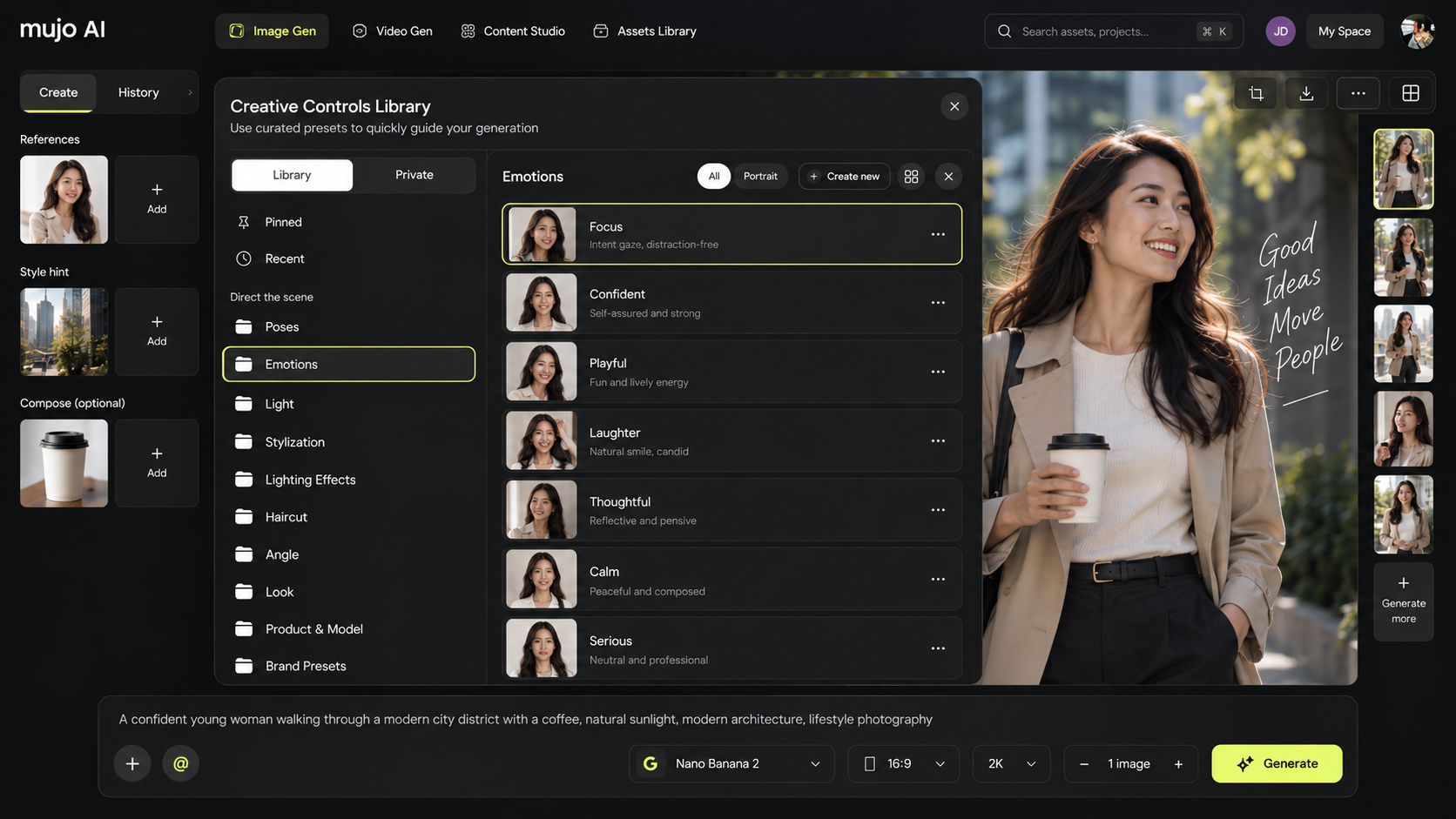
- Then the approved look — saved creative controls, so consistency stops being manual.
- Then characters — the cast, built once and reused.
- Then process — the sequences that repeat, as reusable workflows.
- Finally, volume — bulk production once the inputs are clean.
Doing this in reverse — starting with bulk production on disorganised inputs — produces disorganised output faster, which is how consolidation projects get a bad reputation.
Frequently asked questions
Is one AI platform cheaper than several subscriptions?
Sometimes, but that is the wrong question. The larger costs are fragmented assets, inconsistent output and process that cannot transfer — none of which appear on an invoice.
Do I lose access to specific models by consolidating?
On a multi-model platform you get several providers in one selector rather than one vendor's roadmap. What you may lose is day-one access to a brand-new model before the platform adds it.
What happens to work already made in other tools?
It stays where it was made. This is the practical argument for consolidating early — every month of delay adds references and setups that have to be moved by hand.
Is one platform risky as a single point of dependency?
It is a real trade-off. A platform that connects several model providers reduces model dependency, but your setups and workflows live in it. Judge it the way you judge any core tool, and keep your source references exportable.
When is it too early to consolidate?
When you are still working out what your team does with AI. Consolidating an undefined process is premature; explore first, consolidate once the work repeats.
How do we compare cost between the two?
Add to the subscription total: time spent locating assets, work redone because output did not match, and projects that started from scratch because nothing was reusable. Those three usually dwarf the licence difference.
Can a team run both for a while?
Yes, and most do during a transition. Keep it time-boxed — a permanent hybrid is just fragmentation with an extra invoice.
Count the fragmentation, not the invoices
The decision is not really about price. It is about whether your team's creative process is something that accumulates or something that restarts every project.
If you are one person making individual images, several subscriptions are a perfectly good answer. If you are a team producing campaigns, the question is not what the tools cost — it is what the fragmentation costs, and that figure is not on any invoice.
Every major model. One workspace.
Image and video models, saved setups, reusable workflows and shared review in one place.